

concealed carry

  • New Hampshire Senate Faces Deadline on Campus Carry Vote

    New Hampshire Senate Faces Deadline on Campus Carry Vote

    New Hampshire gun-rights advocates are focusing their attention on the State Senate, urging senators to act immediately on campus carry. Supporters argue that lawmakers have reached a decisive moment and that the next scheduled action is an opportunity to follow through on prior commitments.

    The measure at the center of the dispute involves whether lawful firearm carry should be allowed on college and university property. Backers frame the issue as one of equal rights and personal security, maintaining that adults who can legally carry elsewhere in the state should not lose that ability simply because they step onto a campus.

    According to the call-to-action circulating from advocates, the Senate is expected to take up the campus carry question tomorrow. That timeline has sparked intensified outreach aimed at senators, with supporters pushing for a clear “yes” vote rather than delays, amendments that weaken the proposal, or procedural maneuvers that stall a final outcome.

    From a conservative and libertarian perspective, the argument is fundamentally about limiting bureaucratic control and preserving individual liberty. Proponents contend that campus policies and administrative rules should not override statewide protections for lawful carry, and they emphasize that self-defense is a personal responsibility that does not stop at the edge of a school’s property line.

    The coming Senate action is being treated as a test of whether elected officials will deliver on what advocates describe as a straightforward promise: protect the ability of law-abiding citizens to carry for self-defense, including on campus. With the vote expected tomorrow, supporters are pressing senators to align their decision with constitutional rights and consistent statewide standards.

  • New Hampshire Senate Faces Deadline on Campus Carry Vote

    New Hampshire Senate Faces Deadline on Campus Carry Vote

    New Hampshire gun-rights advocates are focusing their attention on the State Senate, urging senators to act immediately on campus carry. Supporters argue that lawmakers have reached a decisive moment and that the next scheduled action is an opportunity to follow through on prior commitments.

    The measure at the center of the dispute involves whether lawful firearm carry should be allowed on college and university property. Backers frame the issue as one of equal rights and personal security, maintaining that adults who can legally carry elsewhere in the state should not lose that ability simply because they step onto a campus.

    According to the call-to-action circulating from advocates, the Senate is expected to take up the campus carry question tomorrow. That timeline has sparked intensified outreach aimed at senators, with supporters pushing for a clear “yes” vote rather than delays, amendments that weaken the proposal, or procedural maneuvers that stall a final outcome.

    From a conservative and libertarian perspective, the argument is fundamentally about limiting bureaucratic control and preserving individual liberty. Proponents contend that campus policies and administrative rules should not override statewide protections for lawful carry, and they emphasize that self-defense is a personal responsibility that does not stop at the edge of a school’s property line.

    The coming Senate action is being treated as a test of whether elected officials will deliver on what advocates describe as a straightforward promise: protect the ability of law-abiding citizens to carry for self-defense, including on campus. With the vote expected tomorrow, supporters are pressing senators to align their decision with constitutional rights and consistent statewide standards.

  • Garland Dad Defends Family During Carjacking Attempt, Suspect Dies After Struggle

    Garland Dad Defends Family During Carjacking Attempt, Suspect Dies After Struggle

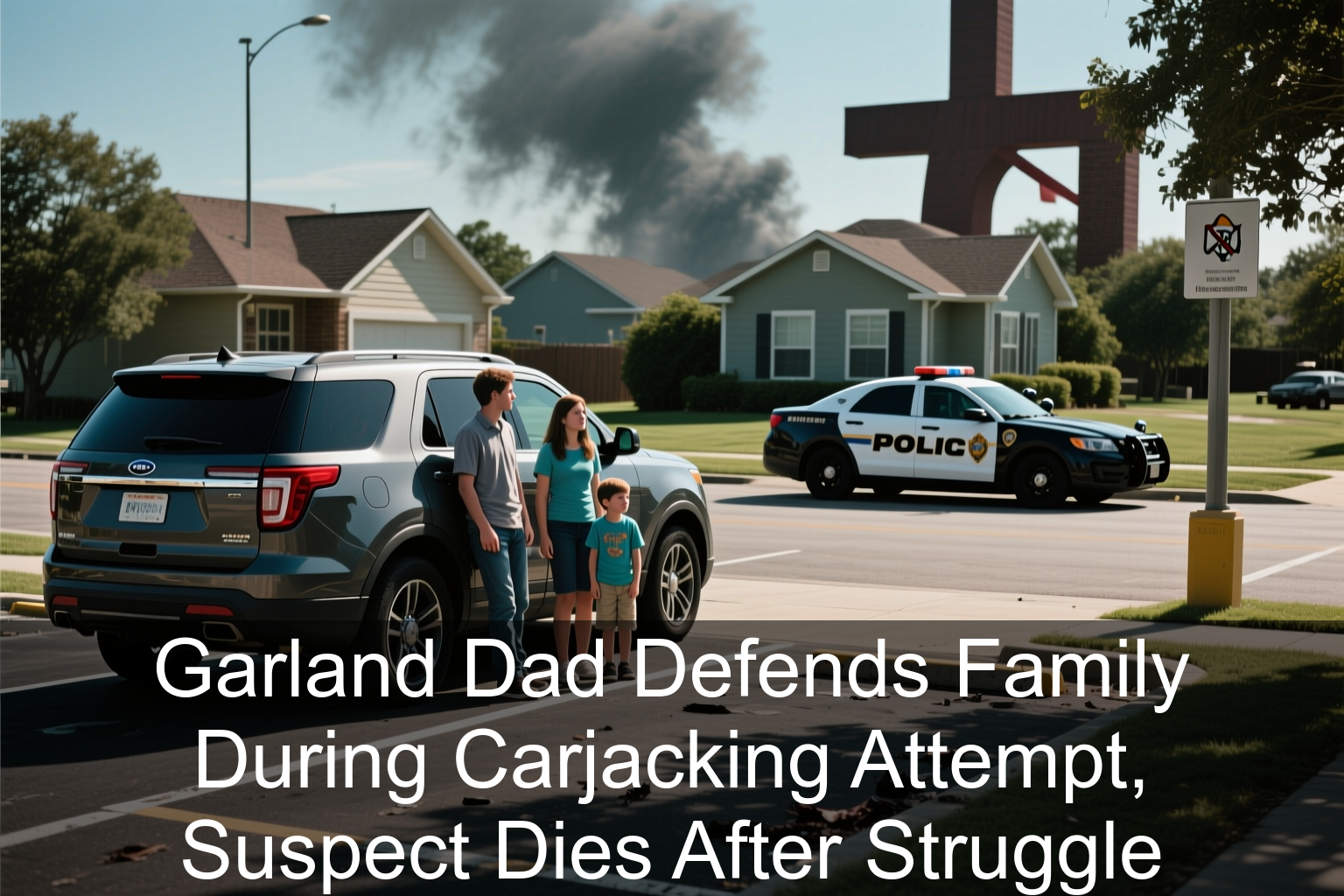
    Authorities in Garland, Texas, say a violent carjacking attempt ended with the suspect fatally shot after confronting a father who had multiple family members inside the vehicle. The incident happened on Sunday afternoon, May 3, 2026, and was captured on surveillance video reviewed by police.

    According to Garland Police Department officials, the suspect tried to take the vehicle while a family of eight was still in it. The father was inside with five children, along with two female passengers, when the attempted theft unfolded.

    Police describe the suspect as unarmed but aggressive, and they say the confrontation turned into an extended physical struggle. Investigators indicate the father fought back as the suspect attempted to gain control of the vehicle with the occupants still present.

    During the confrontation, the father shot the suspect, who later died from his injuries. Officials emphasize that the video evidence supports the conclusion that the father’s actions were taken to defend himself and protect the children and other passengers.

    Garland police have stated that no charges are expected against the father. From a libertarian perspective that recognizes the fundamental right of self-defense, the case underscores a basic reality: when government cannot be everywhere at once, responsible citizens sometimes must act immediately to protect their families from violent threats.

  • Harris County Content Creator Meetup Ends in Shooting After Alleged Robbery Attempt

    Harris County Content Creator Meetup Ends in Shooting After Alleged Robbery Attempt

    A late-morning meet-up between two social media content creators in northwest Harris County erupted into gunfire on Tuesday, April 28, 2026, according to investigators with the Harris County Sheriff’s Office.

    Authorities said the two had arranged to meet to talk about filming content. During the discussion, the encounter allegedly shifted from a planned collaboration into a confrontation inside a Tesla.

    Investigators reported that the passenger pulled out a firearm and attempted to rob the driver. The driver then shot the passenger in the chest, deputies said.

    The shooting was described by investigators as occurring during the attempted robbery, with the driver responding after the passenger allegedly produced a gun. The incident unfolded in northwest Harris County, and it happened late Tuesday morning.

    The case remains tied to an alleged armed robbery attempt during what began as an ordinary content-creation meeting, based on the sheriff’s office account. Deputies have described the sequence as the passenger initiating the threat and the driver firing a single shot that struck the passenger in the chest.

  • Lodestar LNK9 First Look: A 9mm “Smart Gun” That Keeps Traditional Reliability Front and Center

    Lodestar LNK9 First Look: A 9mm “Smart Gun” That Keeps Traditional Reliability Front and Center

    The Lodestar LNK9 enters the “smart gun” category with an approach that aims to satisfy two camps that rarely agree: those who demand old-school mechanical dependability and those who want modern access-control features built into the firearm itself. The pistol is a 9mm platform designed by a veteran, and its core premise is that performance and reliability remain the priority even as optional electronic authorization is added.

    Rather than centering the product around electronics, the LNK9 builds biometric and PIN-based access into the system as an added layer that can be used when desired. This provides a way for an owner to control who can activate the firearm without forcing a one-size-fits-all operating model on everyone. In a space where new technology can sometimes feel like a mandate, Lodestar’s emphasis on choice is a notable part of the concept.

    Security and privacy are also positioned as key elements of the design. Lodestar uses a closed ecosystem described as data-secure, which is meant to limit exposure compared with designs that rely on broader connectivity. For many gun owners concerned about surveillance, unwanted data sharing, or remote interference, a contained system is an important distinction when evaluating any firearm that includes electronics.

    At the same time, the company’s messaging leans heavily on the idea that the LNK9 is still a serious defensive handgun first, and a tech-enabled option second. The electronic safety and authorization components are presented as entirely optional, allowing users to keep the pistol aligned with more traditional expectations of how a defensive sidearm should function. That effort to avoid turning technology into a requirement is central to how the LNK9 is framed.

    Overall, the LNK9 is presented as a step forward in the smart-gun market by attempting to blend modern authorization methods with a high-performance 9mm platform that puts mechanical reliability at the forefront. By combining optional biometric and PIN access with a closed, data-secure ecosystem, Lodestar is positioning the LNK9 as a flexible tool for self-defense—one that seeks to bridge established firearm standards with contemporary security features without forcing owners into a single preferred way of using it.

  • Chicago Armed Citizen Stops Gun-Wielding Robbery Attempt

    Chicago Armed Citizen Stops Gun-Wielding Robbery Attempt

    Chicago saw another reminder that criminals do not always get to choose the outcome of their own crimes. In an incident highlighted by Bearing Arms, an armed resident confronted an alleged robber who was reportedly armed, turning what could have been a one-sided threat into a situation where the intended victim had options.

    According to the account, the suspect initiated an attempted robbery while armed. Instead of complying, the targeted individual was also armed and responded with defensive force, disrupting the robbery attempt and forcing the encounter in a different direction than the suspect likely expected.

    The episode underscores a point often lost in political debates about public safety: ordinary people sometimes face immediate danger without the luxury of waiting for a police response. In those moments, the ability to defend oneself can be the difference between becoming a victim and stopping a violent crime in progress.

    Supporters of the right to keep and bear arms argue that lawful carry is not about looking for conflict, but about being prepared for it when it arrives uninvited. Incidents like this are frequently cited as real-world examples that a would-be attacker cannot assume helplessness from the people they target.

    While broader arguments about gun policy tend to revolve around hypotheticals, this Chicago case centers on a concrete event: an armed robbery attempt met by an armed citizen who refused to be victimized. For many advocates of individual liberty and self-defense, it is further evidence that responsible, law-abiding firearm ownership can play a direct role in deterring crime and limiting harm when danger strikes.

  • Tennessee’s New Law on Using Deadly Force to Protect Property

    Tennessee’s New Law on Using Deadly Force to Protect Property

    NASHVILLE, TN — Tennessee lawmakers are moving a major change in self-defense law toward the governor’s desk, and it’s already reshaping how people think about property crimes like burglary, robbery, and arson.

    As the bill heads for final approval, the practical question isn’t just “Can you use deadly force to protect property?” It’s what the legislation actually adds to existing Tennessee law—and how police and prosecutors are likely to treat a real-world call where someone says they shot to stop a property crime.

    What the bill changes is the set of situations where deadly force can be legally justified. Traditionally, self-defense rules in most states—including Tennessee’s general approach—follow proportionality: lethal force is usually reserved for moments when a person reasonably believes they face imminent death or serious bodily injury. Under that standard, a gun can’t lawfully be used as a tool to settle a minor physical confrontation or to stop a theft when the threat is only to belongings.

    This legislation pushes Tennessee away from that narrow framework by expanding when lethal force may be justified during certain property-related felonies. In effect, it widens the state’s Castle Doctrine concept—commonly understood as the right to defend the home—so that certain property-crime scenarios are treated more like home-defense situations than like ordinary theft or trespass.

    Supporters say the change is meant for law-abiding residents who feel current rules force them to pause while criminals damage or take things they’ve spent years building. During the floor debate, Republican state Rep. Kip Capley argued that, under the current legal expectations, people are effectively told to hold back while someone breaks in, steals, or destroys their property.

    Opponents argue the shift is a step in the wrong direction because it risks elevating property to the level of human life in legal decision-making. Democratic state Rep. Justin Pearson framed the concern in moral and practical terms, saying people are taught not to kill over property because property loss is not the same as putting an innocent life at risk. From that viewpoint, expanding legal justification could lower the bar for bringing a firearm into situations that might otherwise end without someone being shot.

    How would this play out when a 911 call comes in? Even with expanded legal protections, police and prosecutors still have to evaluate the same core issues they always do in a shooting investigation: what crime was occurring, what the shooter believed was happening, whether that belief was reasonable, and whether the force used matched the circumstances allowed by law. The bill may widen the category of incidents where a defense can be raised, but it doesn’t convert every property dispute into an automatic “good shoot.”

    That’s why the safest way to understand the change is this: it may give more people a legal argument after the fact, but it won’t eliminate investigation, scrutiny, or the possibility of arrest and prosecution when facts are unclear or contested. A defender’s statements, surveillance video, witness accounts, and physical evidence will still drive how the case is handled.

    Because the bill is still awaiting the governor’s signature, organizations such as the U.S. Concealed Carry Association say they are preparing to educate members on what the update means in practice. That education matters, because the gap between what people assume the law says and what law enforcement applies at the scene is often where legal trouble begins.

    One point remains true regardless of political side: Tennessee is not turning anyone’s home—or property—into a “free fire” zone. Using deadly force can still bring life-changing legal and financial consequences, even when criminal charges are not filed. If this bill becomes law, the smartest approach for gun owners is to learn the exact boundaries it creates, understand how those boundaries interact with existing self-defense standards, and recognize that every defensive shooting will be judged on the details.

  • Update on the Status of Virginia’s Gun-Control Legislation

    Update on the Status of Virginia’s Gun-Control Legislation

    Virginia’s legislative calendar is quickly approaching the end of the line, and gun policy has been one of the biggest areas of movement in the Commonwealth this year. Over the past few weeks, Gov. Abigail Spanberger has already signed several gun-control measures, and lawmakers have also just wrapped action on a separate set of recommendations she sent back to them for changes.

    As of now, the picture is mixed: a number of bills are already in effect as law, several more are finalized because the legislature accepted the governor’s revisions, and a small but important group is back on her desk in a holding pattern—awaiting a signature, a veto, or inaction that would allow them to take effect.

    Here’s where things stand as the session nears its conclusion, with a focus on which bills are now law and which are still pending final action from the governor.

    Now back on the governor’s desk: still awaiting signature, veto, or no action

    HB217 and SB749: “Assault firearm” sales/transfer ban, but with a key definition fight unresolved
    These companion bills are designed to prohibit future sales and transfers of firearms categorized as “assault firearms.” Gov. Spanberger asked the General Assembly to broaden the initial “assault firearm” definition in a way that would have widened the reach of the restrictions. Lawmakers in both chambers declined to adopt that change and formally chose to “pass by” the bills.

    That decision blocks the governor’s attempt to use the definition change as an indirect way to restrict carrying firearms with magazines over 15 rounds. Because lawmakers did not take up her recommended language, the legislation returns to the governor without the expansion she sought.

    What happens next is entirely up to Spanberger. She can sign the bills as written, veto them, or take no action and allow them to become law. That keeps the session’s most prominent firearms proposal from being fully settled yet, even though a full collapse appears unlikely given Spanberger’s long-standing support for banning AR-15-style rifle sales and restricting “high-capacity” magazines. In her message to legislators, she indicated support for the bills’ overall intent even while pushing for changes. She has 30 days to decide.

    HB229 and SB143: Firearm restrictions at mental health treatment facilities, with an exception preserved
    HB229 (with its related measure SB143) addresses carrying firearms at facilities that provide mental health treatment. The governor asked lawmakers to go further by eliminating an exception that permits staff or security to carry if they have administrative approval.

    The General Assembly again used the “pass by” route, which effectively rejects her requested revision. As a result, the version headed back to Spanberger still includes an option for people to carry with written permission from the facility.

    Just like HB217 and SB749, HB229 now sits in a decision window: signature, veto, or no action within 30 days. Spanberger again signaled support for the bill’s basic goal, but she must decide whether the legislature’s refusal to tighten it further is enough to justify blocking it.

    Now law: bills that became law after lawmakers accepted the governor’s revisions

    HB1524 and SB727: Ban on carrying “assault firearms” in broad public spaces
    Lawmakers agreed to the governor’s requested adjustments to HB1524 and SB727, which prohibit the carrying of “assault firearms.” The change itself was largely technical, tying the carry definition back to the definition used in the pending sales/transfer ban.

    Even with that definitional link, the practical effect of the carry restriction is significant. The law bars civilians from having covered firearms “on or about” their person in a wide range of places, including public streets and sidewalks, as well as public parks. With the legislature approving the governor’s recommendation, these measures have moved into the category of enacted law.

    HB1525: Handgun purchase ban for 18-to-20-year-olds, enacted as emergency legislation with immediate effect
    HB1525 prevents adults aged 18 to 20 from purchasing handguns. At the governor’s request, the legislature converted it into emergency legislation, which makes it effective immediately rather than waiting for the typical July 1 start date used for most new laws.

    Virginia’s constitution generally requires a four-fifths vote in each chamber for emergency legislation. In this case, the emergency clause was inserted through the governor’s recommendation process—an uncommon tactic but one that prior governors, including Republican Glenn Youngkin, have used.

    The bill is aimed at responding to a court decision from last year that struck down Virginia’s universal background check law. The ruling focused on the fact that the federal background check system will not process handgun checks for people under 21, leaving 18-to-20-year-olds with no workable path to complete a legal handgun purchase under the state’s background-check framework. This new law attempts to address that by banning handgun purchases for that age group outright, though it remains uncertain whether this approach resolves the legal concerns identified in the ruling. Virginia Citizens Defense League and Gun Owners of America—plaintiffs in the earlier case—have already warned the Virginia State Police not to enforce the new statute, arguing that enforcement would conflict with the court’s decision.

    HB871 and SB348: Safe storage requirements broadened to include standard gun locks
    With the governor’s recommendation adopted, HB871 now explicitly includes standard gun locks among the devices that satisfy its safe storage rules. The law requires that any firearm not actively being carried on the owner’s person must be secured if a minor or a prohibited person is present in the home.

    HB909: Expanded gun-free areas connected to elections and voter registration, with a timing clarification
    HB909 expands the list of election-related locations where firearms are prohibited and increases the restricted perimeter from 40 feet to 100 feet. The legislature agreed to the governor’s clarification that the ban at a voter registration location applies only while the site is actually being used for voter registration.

    HB1015: Firearm-only prohibition for violent misdemeanor hate crime convictions, plus a pathway to restoration
    HB1015 was modified per the governor’s recommendations so that the weapons restriction for people convicted of violent misdemeanor hate crimes applies to firearms (rather than a broader category of weapons). Lawmakers also accepted a provision allowing affected individuals to regain firearm rights after three years.

    HB101: Electronic applications for concealed carry permits clarified
    HB101 becomes law with language tweaks requested by the governor that clarify Virginians can submit concealed carry permit applications electronically.

    HB702: Local law enforcement “sell-back” program terminology adopted
    HB702 establishes standards for voluntary programs run by local law enforcement. At Spanberger’s request, the language now refers to “sell-back” programs instead of “buy-back” programs. With that adjustment approved, the measure is enacted.

    Already signed into law by Gov. Spanberger: measures enacted earlier in the session

    SB115: End of universal concealed-carry permit reciprocity
    SB115 reverses Virginia’s universal reciprocity approach. Instead of broadly recognizing out-of-state concealed carry permits, Virginia returns to a system where the Attorney General can negotiate individual agreements with other states. The shift is expected to reduce the number of permits Virginia honors, and it may also prompt some states to stop recognizing Virginia permits in return.

    HB110 and SB496: Locked-container requirement for guns left in unattended vehicles
    Under this new law, firearm owners who leave a gun in an unattended vehicle must store it in a hard-sided, locked container or risk a Class 4 misdemeanor. If a gun is stolen, the penalty can still be avoided if the owner reports the theft to law enforcement within 48 hours.

    HB626 and SB272: Firearm ban in public higher-education buildings, with a curriculum/activity exception
    This legislation prohibits bringing firearms into buildings owned or operated by a public institution of higher education, unless the firearm is part of the institution’s curriculum or activities.

    HB901 and SB495: Expansion of Virginia’s “red flag” law and who can seek an order
    This measure broadens Virginia’s extreme risk protective order process. More categories of licensed counselors and medical professionals can request temporary firearm confiscation orders. The law also expands who can file petitions to include immediate family and household members, intimate partners, and school administrators. It further outlines additional factors that may be used to show a person is a danger to themselves or others, including alcohol abuse, threats toward animals, and recent efforts to purchase firearms or ammunition.

    What to watch next as the deadline approaches
    The biggest unresolved question is whether Gov. Spanberger signs, vetoes, or allows the remaining “passed by” bills to become law without her signature—especially the “assault firearm” sales/transfer measures and the mental health facility carry restrictions. With 30 days to act, the governor’s next steps will determine whether the final package matches the legislature’s narrower approach or ends with a late-session standoff.

  • Kentucky Lawmakers Override Governor’s Vetoes on Gun Industry Protections and Young Adult Gun Access

    Kentucky Lawmakers Override Governor’s Vetoes on Gun Industry Protections and Young Adult Gun Access

    Kentucky lawmakers are putting two gun-related bills into effect after overriding Gov. Andy Beshear’s vetoes, a move that immediately changes both the legal landscape for gun-industry businesses and the permitting process for some young adults.

    The Kentucky General Assembly voted April 14, 2026, to override vetoes of House Bill 78 and House Bill 312. With the overrides, the bills become law.

    HB 78: Liability protections take effect immediately
    HB 78 establishes state-level limits on certain civil lawsuits filed against firearm manufacturers, sellers, and trade associations. The law targets what it defines as “qualified civil liability actions” that attempt to hold gun businesses responsible for crimes committed by third parties using legally sold products.

    Supporters of the measure said the bill includes an emergency clause, meaning the liability protections take effect as soon as the override is certified. In practice, that can reduce immediate legal exposure for gun businesses by strengthening defenses against specific categories of claims tied to third-party criminal misuse.

    HB 312: Provisional concealed-carry licenses for ages 18–20
    HB 312 authorizes the Kentucky State Police to issue provisional concealed-carry licenses to adults ages 18 to 20 who meet the state’s requirements. The law aligns the eligibility of 18–20-year-olds with the permitting process used for standard licenses, including background checks and required training.

    For public safety and compliance, applicants and license holders should confirm current rules on where concealed carry is prohibited and follow all state and federal firearm laws. Federal law generally restricts federally licensed dealers from selling handguns to people under 21, which can affect how an 18–20-year-old may lawfully obtain a handgun.

    The governor vetoed both measures, citing safety concerns, but the legislature’s override votes made the bills law.

  • Kentucky Lawmakers Override Governor’s Vetoes on Gun Industry Protections and Young Adult Policies

    Kentucky Lawmakers Override Governor’s Vetoes on Gun Industry Protections and Young Adult Policies

    Kentucky lawmakers are putting two vetoed bills into effect after the General Assembly overrides Gov. Andy Beshear’s vetoes of House Bill 78 and House Bill 312.

    HB 78 changes civil liability rules for parts of the firearms industry. The bill establishes protections for firearm manufacturers, sellers, and trade associations against certain “qualified civil liability actions” that seek to hold those businesses responsible for crimes committed by third parties using firearms. Supporters of the measure describe it as a response to lawsuits they view as attempts to impose costs on lawful businesses.

    The override votes for HB 78 were 80–19 in the Kentucky House and 31–6 in the Senate. The bill includes an emergency clause, meaning the new liability protections take effect immediately upon certification of the override.

    HB 312 expands eligibility for Kentucky concealed-carry licensing by directing the Kentucky State Police to issue provisional concealed carry licenses to adults ages 18 to 20 who meet the required standards. As described by supporters, the provisional license is intended to mirror the main permit process, including background checks, required training, and firearms proficiency.

    The override votes for HB 312 were 81–18 in the House and 28–9 in the Senate.

    For public-safety compliance, anyone seeking to carry under the provisional license must follow the same location restrictions that apply to other concealed-carry license holders under Kentucky law, including prohibited places such as schools and certain government buildings. In addition, federal law places age-based restrictions on purchasing handguns from federally licensed dealers for people under 21, so young adults who carry should ensure any firearm they possess was obtained through a lawful method.

    The Governor said he vetoed HB 78 over concerns that it prioritized protections for gun businesses over safety, and vetoed HB 312 over concerns related to lowering the licensing age. With the veto overrides now certified, both measures become part of Kentucky law and take effect according to their provisions, including HB 78’s immediate implementation clause.