
concealed carry

  • Hazel Park Shooting at Short-Term Rental: Concealed Pistol License Holder Released, City Halts New Rental Permits

    Hazel Park Shooting at Short-Term Rental: Concealed Pistol License Holder Released, City Halts New Rental Permits

    Hazel Park police say a fatal shooting at a short-term rental property on May 29, 2026, has resulted in the release of a 21-year-old man who was initially taken into custody. Investigators concluded the man, who is licensed to carry a concealed firearm, acted in self-defense during an incident that unfolded at a party.

    According to the investigation, the person who died was a 20-year-old man from Detroit. Police allege he pointed a gun at someone attending the gathering while attempting to steal a watch, escalating the situation into a life-threatening confrontation.

    Authorities determined that the 21-year-old concealed carry holder responded to that threat and that the shooting met the standard for self-defense based on the information reviewed by investigators. After being detained while police sorted out what happened, he was later released.

    The case also triggered swift action from city government regarding the property where the party was held. City Manager Ed Klobucher revoked the short-term rental’s license tied to that location, citing the seriousness of the event.

    In addition, Klobucher imposed a citywide pause on issuing new short-term rental licenses. The move effectively freezes expansion of that type of rental in Hazel Park while the city reassesses how these properties are regulated and monitored following the May 29 incident.

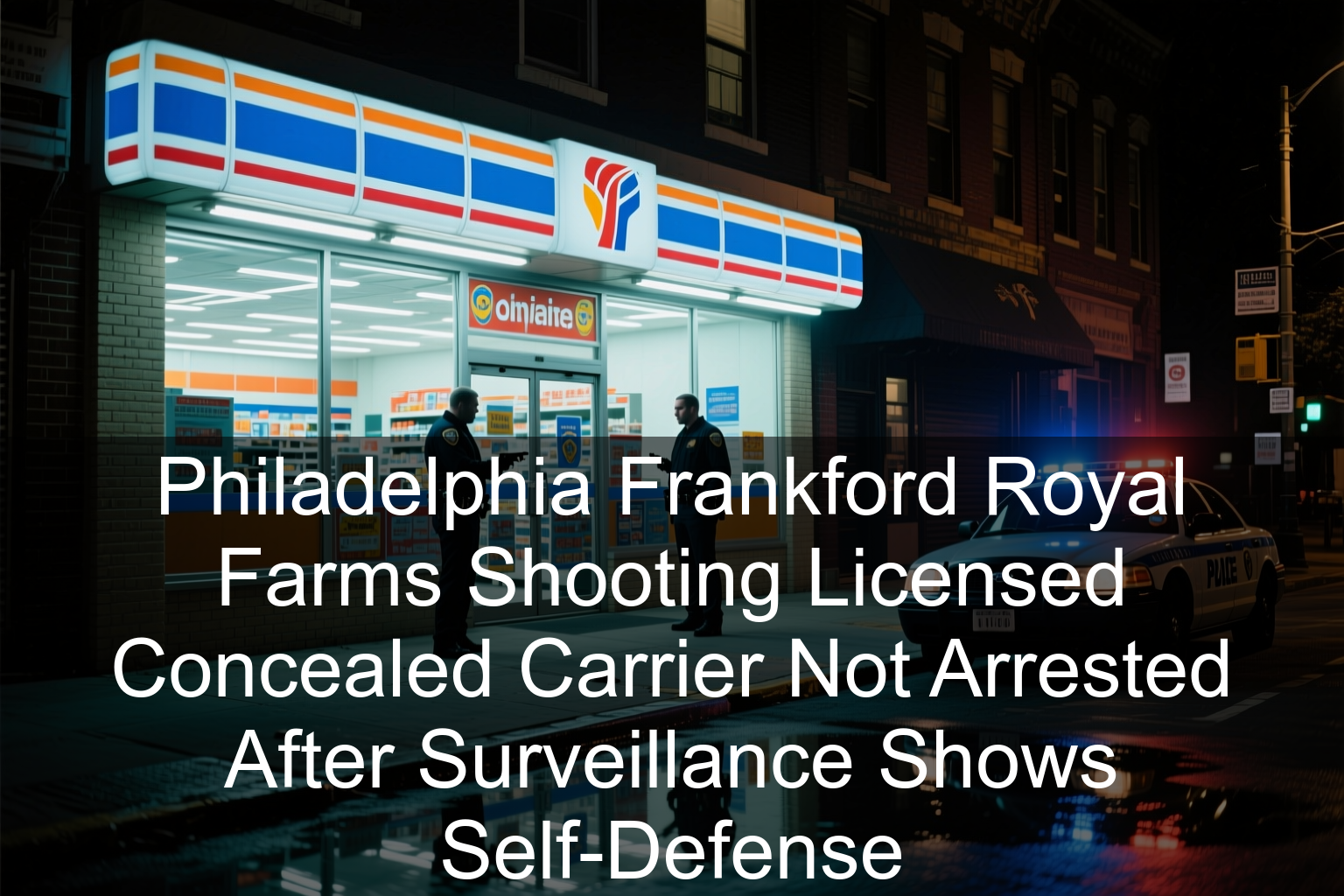
  • Philadelphia Frankford Royal Farms Shooting: Licensed Concealed Carrier Not Arrested After Surveillance Shows Self-Defense

    Philadelphia Frankford Royal Farms Shooting: Licensed Concealed Carrier Not Arrested After Surveillance Shows Self-Defense

    A fatal shooting unfolded late Sunday night at a Royal Farms convenience store in Philadelphia’s Frankford neighborhood, ending with a 22-year-old man dead after a confrontation inside the store. Police reviewed video from the business and treated the incident as a self-defense case involving an armed citizen.

    Investigators said the person who fired the shots was 21 years old and legally carrying a concealed firearm. According to authorities, store surveillance footage captured the older man pointing a gun at the 21-year-old, triggering a rapid, close-range exchange in which the younger man drew his own weapon and fired.

    After examining the video evidence, police did not take the 21-year-old into custody. The decision was tied directly to what investigators described as clear footage showing the younger man responding to an immediate lethal threat rather than initiating the violence.

    The shooting has renewed attention on the reality that violent encounters can erupt without warning in ordinary places like convenience stores, and that the first person to present a firearm can instantly turn a routine stop into a life-or-death emergency. From a pro–self-defense perspective, the case underscores why many law-abiding people choose to carry: the ability to meet force with force when there is no time to wait for help.

    Officials continued to treat the surveillance recording as key evidence as the incident moved forward under the standards that govern defensive gun use. The central facts described by investigators remain that a 22-year-old man was shot and killed, a 21-year-old licensed concealed carrier fired the fatal shots, and police declined an arrest after video showed the deceased man aiming a gun at the shooter first.

  • Non-Resident Carry Lawsuits Face a Tougher Road After Early Post-Bruen Wins

    Non-Resident Carry Lawsuits Face a Tougher Road After Early Post-Bruen Wins

    Gun-rights groups have enjoyed a strong run in court since the Supreme Court’s Bruen decision, particularly when challenging broad, across-the-board state restrictions that blocked non-residents from carrying firearms. Those early cases helped dismantle blanket state-level bans that treated out-of-state permit holders as categorically disqualified, and advocates largely moved from one win to the next.

    That momentum is now meeting a more complicated legal environment. Rather than dealing with straightforward prohibitions that were easier to target, the next wave of litigation is running into a new obstacle that makes expanding non-resident carry less predictable and more difficult than the fights that came immediately after Bruen.

    The practical reality is that as the clearest, most sweeping bans fall, what remains tends to be more layered and harder to challenge cleanly. When a state no longer enforces an outright rule against all non-residents, disputes often shift to narrower policies and administrative frameworks—areas where courts may be less willing to issue broad rulings and where outcomes can hinge on details.

    For supporters of the right to keep and bear arms, that means the post-Bruen “unbeaten streak” is unlikely to translate automatically to the next stage of the campaign. The legal strategy that worked against blanket bans does not always map neatly onto more incremental restrictions, even if the end goal—expanded ability for non-residents to lawfully carry—remains the same.

    The result is a tougher fight ahead for gun-rights advocates seeking broader recognition of carry rights beyond state lines. After a period defined by clear victories against sweeping state policies, the coming battles are set to be more contested, more technical, and less certain in court.

  • Austintown Police Call May 13 Car-Wash Shooting Justified After Armed Attack on Vehicle

    Austintown Police Call May 13 Car-Wash Shooting Justified After Armed Attack on Vehicle

    A fatal shooting near a car wash on New Road in Austintown on Wednesday morning, May 13, 2026, is being classified by local police as a justified act of self-defense. Officials said their review indicates the person who fired did so in response to an immediate, violent threat.

    Investigators pointed to surveillance footage that captured the sequence leading up to the gunfire. According to police, the man who was killed was 30-year-old Zachary Fisher, who was pursuing his ex-girlfriend’s vehicle.

    Authorities said the video shows Fisher chasing the vehicle and then wrecking his truck near the location. Immediately afterward, police reported, he moved to confront the occupied vehicle and began an assault while armed.

    Inside the targeted vehicle were two young children and a male passenger, according to police. Officials said the armed attack on the vehicle occurred with the children still inside, escalating the danger to everyone present.

    Police have stated that, based on the evidence they have reviewed, the shooting is being treated as a clear-cut case of self-defense. From a public-safety and individual-rights standpoint, the incident underscores why lawful self-protection is a fundamental last resort when a violent aggressor forces a life-or-death situation on innocent people.

  • Eighth Circuit Rejects Lawsuit Over Minnesota’s Gun Permit Reciprocity Limits

    Eighth Circuit Rejects Lawsuit Over Minnesota’s Gun Permit Reciprocity Limits

    A federal appeals court has declined to revive a legal challenge aimed at forcing Minnesota to honor more out-of-state handgun carry permits, leaving the state’s current reciprocity boundaries in place. The ruling means Minnesota can continue refusing to recognize certain permits issued elsewhere without being found in violation of the Second Amendment.

    The decision came from the U.S. Court of Appeals for the Eighth Circuit, which dismissed the case rather than sending it forward for further litigation. With that dismissal, Minnesota’s existing approach to recognizing permits from other states remains intact.

    At the center of the dispute was Minnesota’s policy of accepting some outside carry permits while not recognizing others. The plaintiffs argued that the Second Amendment should prevent the state from denying validity to certain permits held by nonresidents or issued under other states’ standards.

    The appellate court did not adopt that theory. By concluding the lawsuit could not proceed, the court effectively accepted that Minnesota’s continued refusal to honor particular carry permits is not, by itself, a constitutional violation under the Second Amendment.

    For gun owners and advocates of nationwide carry recognition, the outcome underscores how much discretion states still have in setting reciprocity rules, even after major Second Amendment decisions in recent years. Unless a different court reaches a contrary conclusion or lawmakers change the rules, Minnesota’s selective recognition of out-of-state carry permits will continue.

  • Best Beginner Concealed Carry Handgun: How to Choose a Safe, Reliable First Pistol

    Best Beginner Concealed Carry Handgun: How to Choose a Safe, Reliable First Pistol

    Choosing a first concealed-carry handgun is less about chasing a trend and more about picking a tool you can operate confidently, carry responsibly, and practice with regularly. For new gun owners, the goal is straightforward: find a pistol that works every time, is comfortable enough to keep on you, and is manageable to shoot so training doesn’t become a frustrating chore.

    Reliability should sit at the top of the list. A carry gun is meant to function when you need it, and beginners are best served by a dependable pistol that runs consistently with quality ammunition and basic maintenance. Alongside that, a beginner-friendly option is one that you can handle well at the range—something controllable in recoil and easy to manipulate—because consistent practice is what builds safe habits and competent marksmanship.

    Safety and day-to-day carry considerations matter just as much as how the gun performs on the firing line. A pistol that is simple to carry securely and safely will be easier to integrate into your routine, which is the entire point of concealed carry. The best option for a new carrier is one that supports careful handling, encourages ongoing training, and fits a responsible approach to personal defense and self-reliance.

    Rather than treating “best” as a single model, the practical approach is to focus on what makes a handgun appropriate for a beginner: a proven track record, shootability that supports learning, and a design you can carry with confidence. If the gun is uncomfortable, difficult to control, or intimidating to operate, many people will avoid practice or stop carrying altogether—both outcomes undermine the purpose of owning it.

    Ultimately, the right concealed-carry handgun for a beginner is the one you can safely manage, comfortably conceal, and commit to training with over time. A clear-eyed selection process—prioritizing reliability, ease of shooting, and safe carry—helps new gun owners make a responsible choice while reinforcing the principle that personal protection is an individual right best exercised with competence and discipline.

  • Second Circuit Rejects New York’s “Vampire Rule,” Restoring Default Carry on Private Property

    Second Circuit Rejects New York’s “Vampire Rule,” Restoring Default Carry on Private Property

    A federal appeals court has ruled against a New York policy that treated most private property as off-limits to lawful firearm carry unless the owner gave specific, affirmative permission. The U.S. Court of Appeals for the Second Circuit struck down the provision often referred to as the state’s “Vampire Rule,” a nickname tied to how the law required property owners to “invite” carry rather than allowing it by default.

    Under the invalidated rule, a person could not carry a firearm onto private property unless the owner had expressly allowed it. In practical terms, that approach flipped the normal presumption on its head and forced businesses and property owners to proactively opt in, instead of letting them set restrictions only when they chose to do so.

    With the Second Circuit’s decision, the default framework returns to one that is more familiar in many states: lawful carry in businesses is permitted unless the property owner posts signage or otherwise communicates a prohibition. Property rights remain central under this approach—owners can still exclude firearms—but the burden is no longer on every owner to grant explicit permission before lawful carry is allowed.

    The ruling is being viewed as a significant win for gun-rights advocates because it blocks a broad, statewide ban that effectively covered large swaths of ordinary, everyday locations. At the same time, the court did not wipe away all location-based limits and left intact certain restrictions in places deemed “sensitive.”

    Among the limits the court kept in place are restrictions in public parks. As a result, while the decision narrows New York’s ability to impose a sweeping default ban on private property, it also confirms that the state can still enforce some carry prohibitions in specific categories of public locations.

  • Second Circuit Blocks New York’s Presumed Ban on Carrying Firearms on Private Property Open to the Public

    Second Circuit Blocks New York’s Presumed Ban on Carrying Firearms on Private Property Open to the Public

    A federal appeals court has rejected a key part of New York’s approach to restricting where licensed citizens may carry firearms. The U.S. Court of Appeals for the Second Circuit concluded the state cannot treat privately owned property that is open to the public as automatically off-limits to permit holders.

    At the center of the dispute was a New York rule critics dubbed the “vampire rule,” a reference to the idea that lawful carry rights effectively disappear unless a property owner gives explicit permission. Under that framework, a person with a valid carry license could be presumed barred from bringing a firearm onto any private property that is publicly accessible unless the owner affirmatively allowed it.

    The Second Circuit’s decision means New York may not impose a blanket presumption that licensed carry is forbidden across all such locations. Instead, the ruling recognizes that property owners remain free to set their own policies, but the state cannot preemptively convert every publicly accessible private space into a default prohibited zone for law-abiding licensees.

    The case highlights an ongoing tension between broad state-level restrictions and the day-to-day reality of ordinary places people pass through—shops, businesses, and other privately owned locations that invite the public in. From a liberty-minded perspective, the decision reinforces the principle that constitutional rights should not be treated as privileges that vanish in most real-world settings by default.

    While the ruling narrows New York’s ability to presume a ban, it does not remove a property owner’s authority to decide what is allowed on their premises. The key change is who makes the choice: the court’s decision prevents the state from making the default decision for every owner and every publicly accessible private property as a matter of law.

  • Vermont Senate Moves S. 329 Forward to Ban Firearms in Bars and Alcohol-Serving Restaurants

    Vermont Senate Moves S. 329 Forward to Ban Firearms in Bars and Alcohol-Serving Restaurants

    A proposal in Montpelier is gaining traction that would create a uniform statewide rule limiting where firearms may be carried. The Vermont Senate has advanced S. 329, a measure aimed at prohibiting firearms inside bars and in restaurants that serve alcohol.

    Supporters of the bill argue that the state should set one consistent policy rather than leaving the issue to piecemeal local action. In practice, S. 329 is intended to replace a separate effort tied to Burlington—an attempted charter change that has remained stuck for an extended period—by establishing a single standard across Vermont.

    The Senate’s initial approval came through a vote split along party lines. While the bill is moving ahead legislatively, it is already heading toward a major obstacle at the executive level.

    Governor Phil Scott is widely expected to reject the measure if it reaches his desk. He has previously indicated doubts about whether such a prohibition can be effectively enforced, raising questions about how the policy would work in real-world settings.

    For Vermonters who prioritize individual liberty and consistent statewide rules, the debate is likely to center on whether restricting lawful carry in specific public venues improves safety or mainly creates new compliance issues for responsible citizens. As S. 329 continues through the process, the prospects for enactment appear tied not only to legislative votes, but also to the likelihood of a gubernatorial veto.

  • ATF Rule Changes and the Practical Impact on Gun Owners and FFLs

    ATF Rule Changes and the Practical Impact on Gun Owners and FFLs

    Federal firearms regulation is entering another adjustment period as the Bureau of Alcohol, Tobacco, Firearms and Explosives rolls out updated rules aimed at reshaping how oversight works for both Federal Firearms Licensees (FFLs) and everyday gun owners. The stated purpose is to increase openness and strengthen accountability in how the agency regulates the firearms marketplace. For many Americans who value limited government, the bigger question is whether these changes will function as genuine reform or simply expand bureaucracy under a new label.

    These rule updates focus heavily on the relationship between the ATF and license holders. FFLs sit at the center of lawful firearm commerce, and any regulatory shift tends to affect the entire system—from how transactions are handled to how compliance expectations are communicated and enforced. By presenting the changes as a move toward transparency, the agency signals that it intends to clarify standards and make oversight more consistent. Whether that clarity reduces uncertainty for businesses or creates additional administrative burdens will depend on how the rules are implemented in practice.

    Gun owners are also affected because the rules that govern licensees can ripple outward into the purchasing process, transfers, and the broader availability of lawful services. When policy changes alter how dealers operate, customers often experience the results through new procedures, longer timelines, or shifts in what businesses are willing to do to avoid compliance risks. Supporters of individual liberty typically want a system that targets actual criminal behavior while keeping lawful ownership and commerce straightforward and predictable.

    The reform framing suggests the ATF is attempting to address criticism about uneven enforcement and opaque decision-making. For conservatives and libertarians, accountability is not just a slogan—it should mean clear, stable rules that do not change depending on region, administration priorities, or internal interpretations that the public cannot easily evaluate. Transparency, in this sense, should include understandable guidance, consistent expectations, and a fair process that respects due process for licensees who are trying to comply in good faith.

    As these new rules take hold, FFLs and gun owners alike will be watching for the real-world effects: whether compliance becomes more manageable and predictable, or whether the regulatory footprint grows in ways that discourage lawful commerce. The outcome matters not only to businesses and customers, but also to the broader principle that constitutional rights should not be constrained by shifting administrative policy. The practical test will be whether the ATF’s promised transparency and accountability translate into measurable restraint and clarity rather than expanded red tape.