
Virginia

  • Virginia Prosecutors in Four Counties Say They Won’t Bring Charges Under New “Assault Weapons” Ban

    Virginia Prosecutors in Four Counties Say They Won’t Bring Charges Under New “Assault Weapons” Ban

    Several elected Commonwealth’s Attorneys in Virginia are publicly signaling they do not intend to pursue criminal cases under the state’s new “assault weapons” restrictions once the measures begin. Their announcements come ahead of the July 1, 2026 effective date for the legislation.

    The prosecutors involved represent at least four counties: Spotsylvania, Powhatan, Pulaski, and Smyth. Each has stated that their offices will decline to prosecute alleged violations tied to the new ban, framing the decision as an exercise of prosecutorial discretion rather than a lack of awareness about what the new statutes will require.

    The laws at the center of the dispute are SB 749 and HB 217. According to the prosecutors’ statements, they expect that when these laws take effect, charges submitted under those provisions will be rejected by their offices, meaning cases would not move forward in their jurisdictions based on those statutes alone.

    In explaining their position, the prosecutors have pointed to what they describe as the superior authority of the Second Amendment. They argue that constitutional protections for keeping and bearing arms outweigh the state’s new restrictions, and they cite that belief as a central reason for refusing to file or pursue prosecutions under the coming ban.

    This emerging standoff sets up a significant conflict inside Virginia’s criminal-justice system, as enforcement of a statewide firearms policy may vary depending on local prosecutorial decisions. With the start date of July 1, 2026 approaching, the gap between state lawmakers’ intent and local prosecutors’ willingness to enforce the ban is becoming a major point of contention.

  • Virginia Prosecutors in Four Counties Say They Won’t Bring Charges Under New “Assault Weapons” Ban

    Virginia Prosecutors in Four Counties Say They Won’t Bring Charges Under New “Assault Weapons” Ban

    Several elected Commonwealth’s Attorneys in Virginia are publicly signaling they do not intend to pursue criminal cases under the state’s new “assault weapons” restrictions once the measures begin. Their announcements come ahead of the July 1, 2026 effective date for the legislation.

    The prosecutors involved represent at least four counties: Spotsylvania, Powhatan, Pulaski, and Smyth. Each has stated that their offices will decline to prosecute alleged violations tied to the new ban, framing the decision as an exercise of prosecutorial discretion rather than a lack of awareness about what the new statutes will require.

    The laws at the center of the dispute are SB 749 and HB 217. According to the prosecutors’ statements, they expect that when these laws take effect, charges submitted under those provisions will be rejected by their offices, meaning cases would not move forward in their jurisdictions based on those statutes alone.

    In explaining their position, the prosecutors have pointed to what they describe as the superior authority of the Second Amendment. They argue that constitutional protections for keeping and bearing arms outweigh the state’s new restrictions, and they cite that belief as a central reason for refusing to file or pursue prosecutions under the coming ban.

    This emerging standoff sets up a significant conflict inside Virginia’s criminal-justice system, as enforcement of a statewide firearms policy may vary depending on local prosecutorial decisions. With the start date of July 1, 2026 approaching, the gap between state lawmakers’ intent and local prosecutors’ willingness to enforce the ban is becoming a major point of contention.

  • Virginia Gov. Spanberger Enacts SB 749 Assault Weapons Ban, Prompting Two Rapid-Fire Legal Challenges

    Virginia Gov. Spanberger Enacts SB 749 Assault Weapons Ban, Prompting Two Rapid-Fire Legal Challenges

    Virginia has enacted a major new firearms restriction after Governor Abigail Spanberger signed Senate Bill 749 into law. The measure creates a statewide prohibition on what the statute labels “assault weapons” as well as a ban on “high-capacity” magazines.

    The law is not immediate. Its effective date is set for July 1, 2026, giving residents, retailers, and law enforcement a defined timeline before the new rules take effect.

    Even with that delayed start, opponents moved quickly to contest the policy in court. The signing was followed right away by two separate lawsuits, each taking a different route to challenge the legislation.

    One case was filed in Virginia’s state courts by Gun Owners of America (GOA) and the Virginia Citizens Defense League (VCDL). Their approach relies on a distinctive argument grounded solely in the Virginia Constitution, aiming to keep the dispute framed as a state-law question rather than a federal one.

    A second challenge was filed in federal court by the National Rifle Association (NRA) and the Firearms Policy Coalition (FPC). That filing is structured to pursue a streamlined path that seeks to avoid review in the U.S. Court of Appeals for the Fourth Circuit and instead position the case to reach the U.S. Supreme Court as directly as possible.

    Together, the paired lawsuits set up a two-front legal fight—one focusing on state constitutional claims and the other targeting federal review—over a law that bans specified firearms and magazines across Virginia beginning July 1, 2026.

  • Virginia Enacts “Assault Weapon” and Magazine Limits, Shifting the Fight to the Courts

    Virginia Enacts “Assault Weapon” and Magazine Limits, Shifting the Fight to the Courts

    Virginia’s debate over restricting certain firearms and ammunition magazines has moved into a new phase. After a prolonged period of uncertainty, the proposals targeting so-called “assault weapons” and magazines are no longer merely pending ideas. They are now part of state law, closing out the immediate legislative contest.

    With enactment complete, the next arena is the judiciary. The push to reverse these new limits is expected to take shape through lawsuits aimed at invalidating the bans. In other words, the political process has produced an outcome, and opponents are now preparing to challenge that outcome through legal claims.

    From a conservative and libertarian standpoint, this transition matters because it changes what success looks like. Instead of persuading lawmakers or the governor, critics must now convince judges that the restrictions cannot stand under the relevant constitutional standards that govern firearms regulations.

    The road ahead will likely be defined by procedural choices as much as headline issues: who brings the case, where it is filed, and what immediate relief is requested. The initial legal actions will shape the pace and direction of the broader effort to roll back the newly enacted hardware and magazine rules.

    For supporters of robust Second Amendment protections, the immediate takeaway is straightforward: the policy fight has ended for now, but the contest over rights and limits is only beginning. The practical path forward runs through litigation intended to undo Virginia’s “assault weapon” and magazine bans now that they have become law.

  • NSSF Backs Lawsuit Challenging Virginia’s HB 217 and SB 749 Firearm Ban

    NSSF Backs Lawsuit Challenging Virginia’s HB 217 and SB 749 Firearm Ban

    NSSF, the trade association representing the firearm industry, announced in Washington, D.C., that it is financing a newly filed lawsuit against the Commonwealth of Virginia. The organization says the case challenges state actions it believes conflict with both the U.S. Constitution and the Virginia Constitution.

    At the center of the dispute is Virginia’s recently enacted legislation identified as HB 217 and SB 749. According to NSSF, the law is sweeping in scope and imposes a prohibition involving certain firearms.

    NSSF states the statute bars the sale and transfer of firearms that, in its view, are specifically protected for private ownership under constitutional guarantees. The lawsuit, NSSF says, is aimed at stopping what it characterizes as unconstitutional restrictions embedded in the new measure.

    By choosing to fund the litigation, the organization is positioning the courts as the venue to resolve whether Virginia’s approach aligns with constitutional limits. The filing signals that the debate over how far state government can go in regulating commonly owned firearms is likely to continue in courtroom proceedings.

    NSSF’s announcement frames the legal challenge as a direct response to the enactment of HB 217 and SB 749 and the restrictions the organization says those bills impose on lawful commerce and private transfers. The case now turns on judicial review of the law’s compatibility with the federal and state constitutions cited in the complaint.

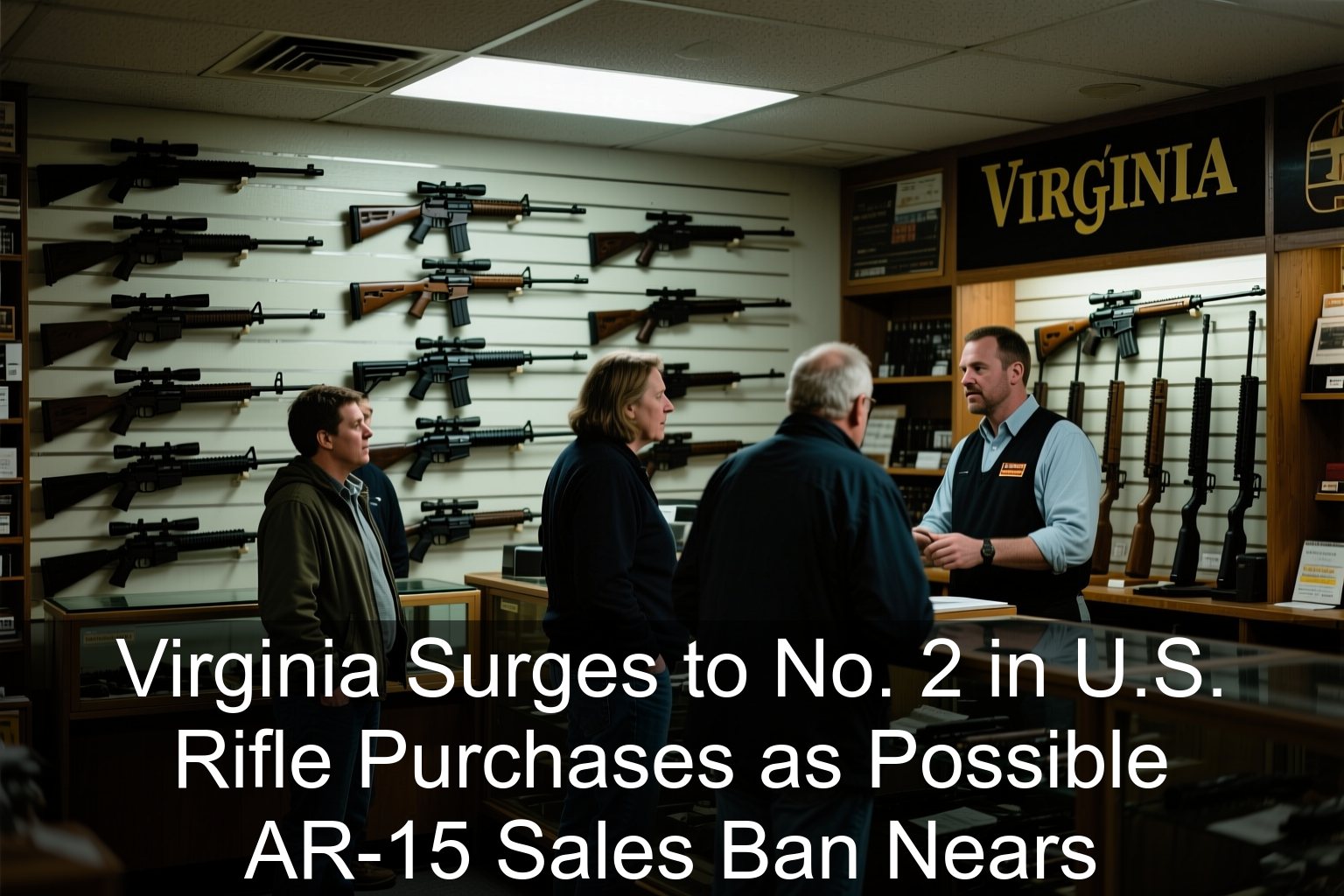
  • Virginia Surges to No. 2 in U.S. Rifle Purchases as Possible AR-15 Sales Ban Nears

    Virginia Surges to No. 2 in U.S. Rifle Purchases as Possible AR-15 Sales Ban Nears

    Virginia has climbed to the second-highest spot nationally for rifle purchases as residents move quickly to buy firearms and standard-capacity magazines amid uncertainty over a potential state crackdown. The shift comes as lawmakers advance restrictions that could soon limit what can be sold, prompting many buyers to act before any new rules take effect.

    The immediate driver is pending legislation that would prohibit the sale of commonly owned semi-automatic rifles, including AR-15-style firearms, along with the ammunition magazines typically sold with them. Rather than waiting for the governor’s decision, Virginians have been heading to gun shops now, treating the current window as possibly their last chance to purchase the affected items through normal retail channels.

    This rush has reordered where Virginia sits compared with other states, pushing it near the top of the national rankings for rifle sales. The jump reflects a familiar pattern seen in other jurisdictions: when a ban is proposed or close to being signed, demand accelerates as citizens try to secure lawful products before the market changes.

    From a conservative and libertarian perspective, the situation underscores how regulatory threats can distort consumer behavior and burden ordinary people who want to exercise a fundamental right without being forced into a last-minute scramble. It also highlights the practical reality that bans often push otherwise routine purchases into a time-sensitive decision driven by politics rather than personal readiness or long-term planning.

    For now, the outcome hinges on whether the governor signs the measure. Until that decision is made, Virginia’s gun retailers and buyers are operating in a climate shaped by the possibility that sales of popular semi-automatic firearms and their standard magazines could soon be off-limits in the state.

  • Virginia Senators Push Federal Gun-Control Agenda Beyond State Lines

    Virginia Senators Push Federal Gun-Control Agenda Beyond State Lines

    Two U.S. senators from Virginia are being criticized by gun-rights advocates for promoting a national approach to firearms policy that mirrors strategies used in their home state. Critics argue the effort is designed to export restrictive measures nationwide rather than leave such decisions to states and local communities.

    The concern, as framed by opponents, is not simply about individual bills but about a broader governing philosophy that treats gun ownership as something to be constrained through layered regulations. From a conservative and libertarian perspective, that approach is viewed as incompatible with the Second Amendment and with the idea that constitutional rights should not depend on shifting political majorities.

    Gun-rights groups also object to the federalization of policies that have been fought over at the state level, warning that a Washington-driven framework can override regional differences and weaken accountability. They argue that when rules are set nationally, citizens have fewer practical options to resist, revise, or replace policies that they believe infringe on fundamental liberties.

    The push has been characterized by critics as part of a larger national gun-control campaign in which elected officials use federal power to impose limitations that might not pass in many states on their own. Opponents say this strategy relies on central authority to achieve outcomes that are politically difficult to secure through a more decentralized system.

    Supporters of stronger gun restrictions generally frame their priorities as public-safety measures, while opponents counter that the practical effect is to burden lawful owners rather than stop criminals. In that view, expanding Virginia-style tactics across the country risks turning a contested state-level agenda into a uniform federal standard.

    The dispute underscores an ongoing national divide: whether firearms policy should be tightened through broader regulation or whether policymakers should prioritize enforcement of existing laws while protecting the right of law-abiding citizens to keep and bear arms. For critics of the Virginia senators’ direction, the central issue is preventing what they see as an aggressive, top-down attempt to reshape gun rights across the entire United States.

  • Virginia Gun Control Bill Nears Final Form After Legislature Rejects Governor’s Key Change

    Virginia Gun Control Bill Nears Final Form After Legislature Rejects Governor’s Key Change

    Virginia’s gun-control package is now close to its endgame after lawmakers turned aside several of Gov. Abigail Spanberger’s most consequential requested edits, a decision that narrows what will change immediately and clarifies what still hinges on her next move.

    The turning point came Wednesday, when the Democratically controlled Senate and House of Delegates voted on multiple recommendations Spanberger sent back to them. Virginia’s process gives the governor unusual leverage at this late stage, allowing her to propose alterations after bills have already cleared the General Assembly. This week’s votes show that leverage has limits when the legislature isn’t willing to expand a bill beyond what it originally passed.

    The biggest practical effect of the rejection involves ammunition magazines. Spanberger had pushed for a tighter approach that would have functioned as a carry ban on magazines capable of holding more than 15 rounds. Lawmakers declined to adopt that change, meaning the final version won’t include that added restriction she sought.

    Legislators also refused another significant request tied to the new ban on guns in mental health hospitals. The governor wanted to remove an exception included by the legislature, but the House and Senate voted against stripping it out. As a result, the exception remains part of the bill that’s heading back to the executive branch.

    Even with the governor’s preferred expansions blocked, the overall scope of Virginia’s 2026 gun policy changes remains large. As of this week, 11 new gun-control bills have already completed the legislative process to the point that they’ve “made it across the finish line,” though two of the most far-reaching measures are still, at least technically, unresolved.

    Now, the measures lawmakers declined to amend return to Spanberger’s desk. From here, she has three options on each bill: sign it, veto it, or do nothing and allow it to become law without her signature. Those choices will determine not only which restrictions take effect, but also how quickly Virginia’s new rules solidify after a session that’s already produced the state’s biggest shift in gun policy in a long time.