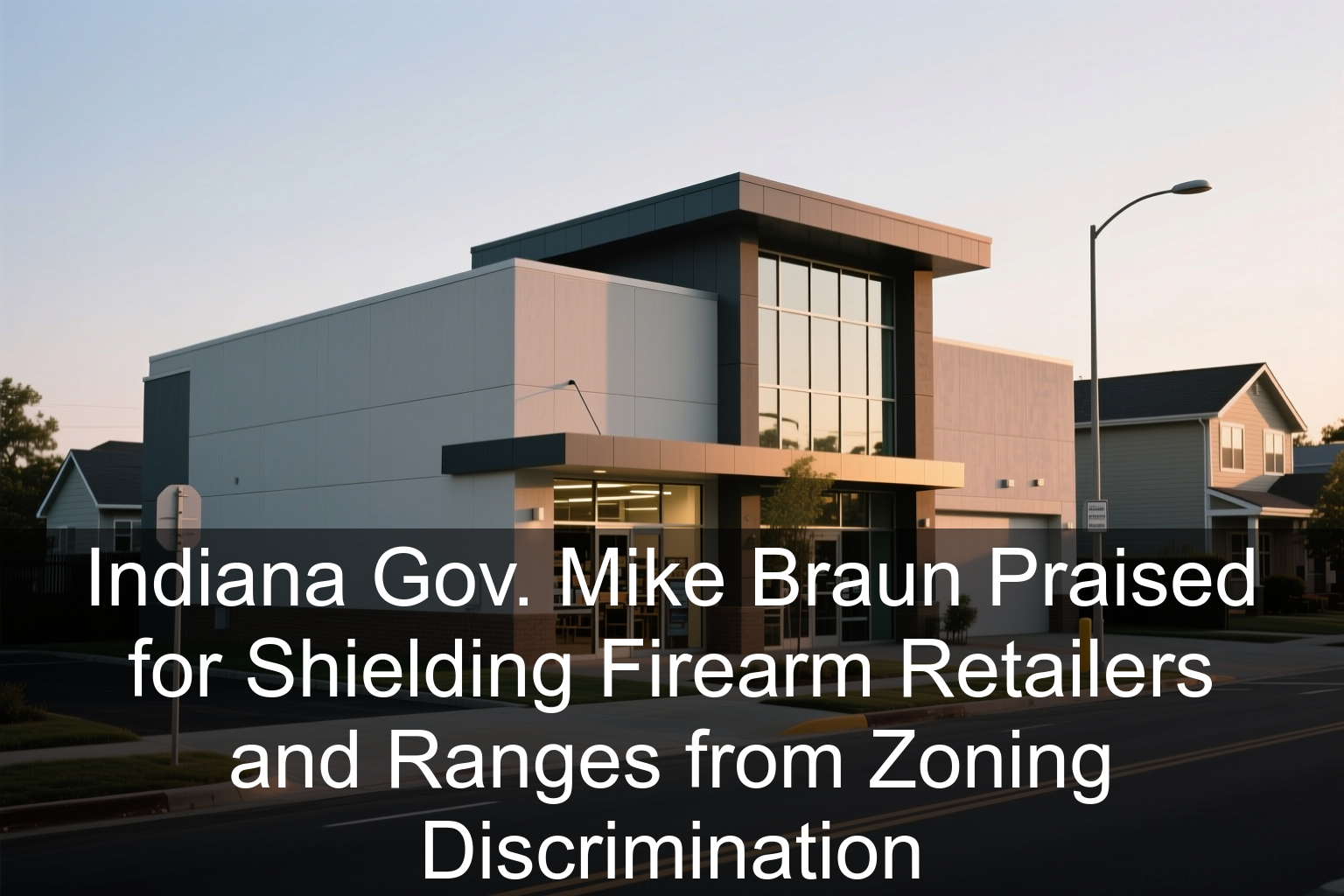

Indiana is about to tighten the rules on how local zoning can be used against firearm businesses. With Gov. Mike Braun’s signing of Senate Enrolled Act 176 (SEA 176), cities and counties will face clearer limits on what they can demand, delay, or deny when it comes to firearm retailers and indoor shooting ranges—especially in areas that are already zoned for commercial activity.
The practical shift starts July 1, 2026, when SEA 176 takes effect. From that date forward, local governments in Indiana are no longer free to use zoning as a workaround to block gun shops or ranges that otherwise fit within established zoning categories. Supporters, including the National Shooting Sports Foundation (NSSF), describe the law as a response to jurisdictions that have attempted to “weaponize” zoning to keep firearm-related businesses out, even when the underlying land use would normally allow retail or similar commercial operations.
A key part of the law is how it treats existing shooting ranges. SEA 176 spells out that routine improvements and upkeep—maintenance, repairs, modernization, and similar work—are considered part of an already approved use. In other words, if a range is already lawful at its location, the city or county cannot force it into a new permitting process just because the owner is upgrading equipment, fixing the building, or making the facility more modern.
SEA 176 also targets permit conditions that have little to do with land use. For example, it bars local governments from tying permit approval to demands such as annexation. At the same time, it adds a timing expectation: local governments must act within a reasonable timeframe when processing permits for ranges, limiting the ability to stall a project through inaction.
For new indoor shooting ranges, SEA 176 lays out a default rule that matters to anyone considering expansion or a new build. Indoor ranges are treated as permitted uses in areas zoned for commercial, industrial, or agricultural purposes, and they generally cannot be forced into extra special hearings or discretionary approvals just because they are ranges. The statute does recognize limited exceptions, but the baseline is that if the zoning category is already compatible, the range can proceed without being singled out for additional local gatekeeping.
The law still expects indoor ranges to be built responsibly. SEA 176 includes facility standards requiring that the range be constructed so projectiles remain contained inside the building. It also sets a noise-related requirement: the range must be designed so that noise does not significantly affect neighboring properties. In practice, this pushes compliance toward sound mitigation and safe backstop/containment design as a matter of meeting state law expectations, not as a locally imposed barrier unique to firearm businesses.
Gun shops and similar retailers are addressed with equal specificity. SEA 176 defines a “retail sporting goods store” as a business primarily engaged in the retail sale of new sporting goods under NAICS 45110, a classification that includes gun shops and sporting goods stores. That definition matters because it helps determine how a firearm retailer is treated in local zoning—by clarifying that these businesses fit within a recognized retail category rather than being treated as a special-use outlier.
Under SEA 176, new firearm retailers will generally be allowed on parcels that are zoned for commercial use, again with limited exceptions. The intent is straightforward: if a community has designated an area for commercial activity, it cannot selectively carve out firearm retail as a prohibited “special case” through zoning discrimination.
The enforcement reality beginning July 1 is that local governments will need to align their permitting practices and zoning interpretations with the new statewide standards. For operators and developers, that means the compliance conversation should shift away from arguing whether a lawful commercial use can be blocked, and toward demonstrating that the project meets the law’s practical safety and noise expectations—while also tracking whether the locality is processing permits in a timely manner and without improper conditions.
SEA 176 was carried in the Indiana legislature by State Sen. Jim Tomes and State Rep. Ben Smaltz. Gov. Braun signed the measure earlier this year, and a ceremonial signing is scheduled for late April. NSSF, the firearm industry trade association, publicly praised the law and framed it as a protection against zoning tactics that, in their view, push ranges and retailers into remote, hard-to-access locations—an issue they say affects everyday consumers, hunters, and law enforcement.
From July 1 forward, the message for Indiana cities and counties is that zoning categories must be applied consistently. And for firearm retailers and range operators, SEA 176 provides a clearer legal framework for where these businesses can operate, what upgrades can move forward without being re-permitted, and what kinds of local hurdles are no longer allowed.