
gun rights

  • ATF Moves to Undo Pistol Brace, “Ghost Gun,” and Dealer Rule Changes

    ATF Moves to Undo Pistol Brace, “Ghost Gun,” and Dealer Rule Changes

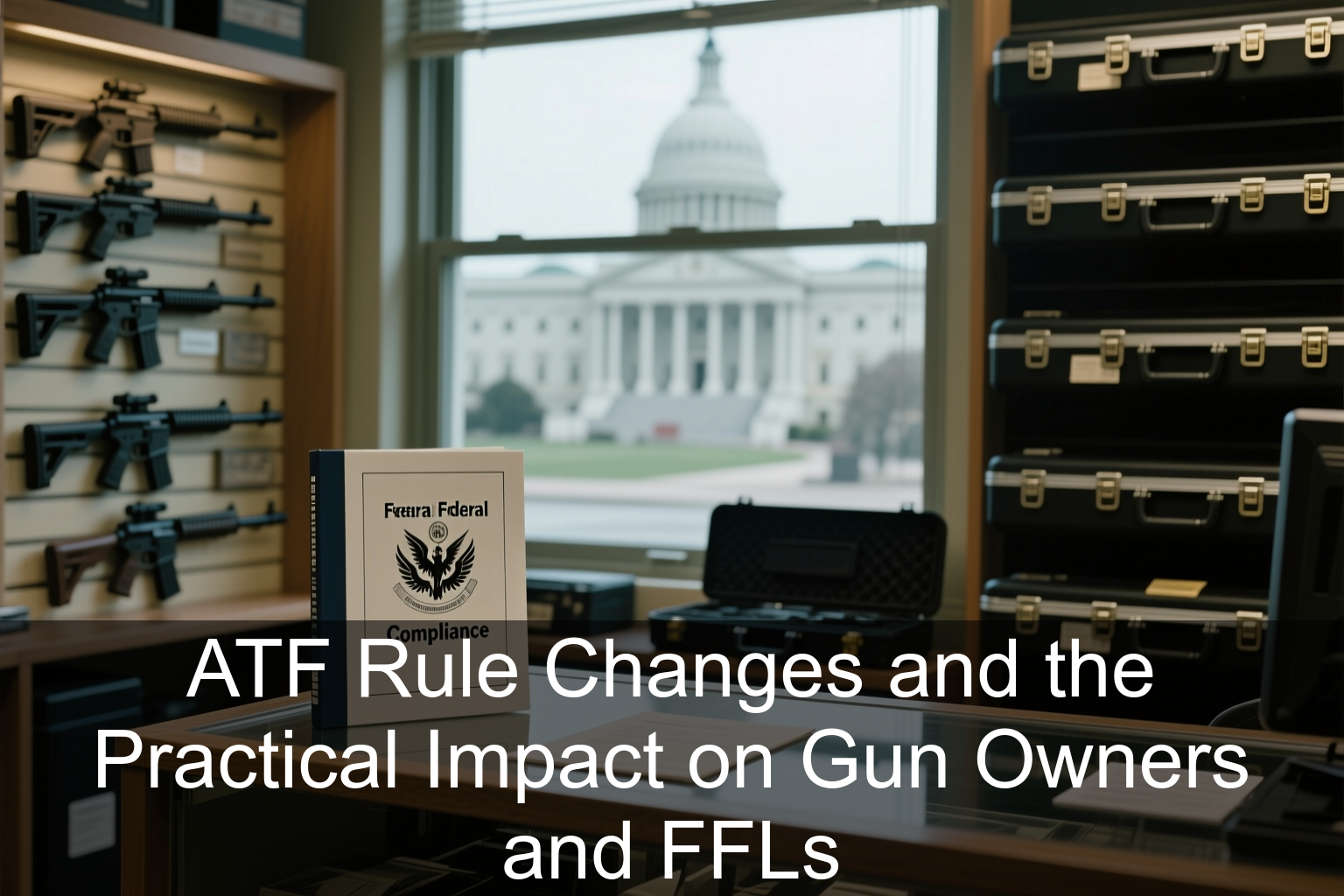
    Federal gun policy may be headed for a major reset after the Bureau of Alcohol, Tobacco, Firearms and Explosives released new documents outlining how it intends to roll back several high-profile regulations adopted in recent years. The agency’s latest publications indicate that multiple rules that reshaped how certain firearms and gun businesses are treated under federal law could be formally withdrawn.

    At the center of the changes are three regulations that have drawn intense debate over roughly the last seven years. The ATF’s newly published details point toward eliminating each of these measures through the federal rulemaking process, which would remove them from the books once completed.

    One of the targeted rules is the pistol brace regulation, a policy that affected how braced pistols were classified and whether they would be treated similarly to firearms regulated under the National Firearms Act. Another is the rule commonly associated with “ghost guns,” which addressed the status of privately made firearms and items such as frames and receivers. The third is the firearm dealer rule, which changed how federal authorities interpret who is considered to be “engaged in the business” of dealing firearms and therefore required to obtain a federal firearms license.

    From a libertarian-leaning perspective, the significance of the ATF’s move is that it signals a retreat from regulatory expansions that many gun owners and small businesses viewed as unclear, burdensome, or beyond what Congress explicitly authorized. Supporters of the rollbacks argue that major shifts in gun law should be decided by lawmakers rather than implemented through agency rule changes that can rapidly alter compliance expectations.

    For now, the key development is the publication of the agency’s rollback plans and supporting information, which lays out the path for these rules to “officially disappear” if the process is carried through. The outcome will determine whether the three controversial regulations remain in force or are replaced by a return to prior federal interpretations.

  • New Hampshire Senate Faces Deadline on Campus Carry Vote

    New Hampshire Senate Faces Deadline on Campus Carry Vote

    New Hampshire gun-rights advocates are focusing their attention on the State Senate, urging senators to act immediately on campus carry. Supporters argue that lawmakers have reached a decisive moment and that the next scheduled action is an opportunity to follow through on prior commitments.

    The measure at the center of the dispute involves whether lawful firearm carry should be allowed on college and university property. Backers frame the issue as one of equal rights and personal security, maintaining that adults who can legally carry elsewhere in the state should not lose that ability simply because they step onto a campus.

    According to the call-to-action circulating from advocates, the Senate is expected to take up the campus carry question tomorrow. That timeline has sparked intensified outreach aimed at senators, with supporters pushing for a clear “yes” vote rather than delays, amendments that weaken the proposal, or procedural maneuvers that stall a final outcome.

    From a conservative and libertarian perspective, the argument is fundamentally about limiting bureaucratic control and preserving individual liberty. Proponents contend that campus policies and administrative rules should not override statewide protections for lawful carry, and they emphasize that self-defense is a personal responsibility that does not stop at the edge of a school’s property line.

    The coming Senate action is being treated as a test of whether elected officials will deliver on what advocates describe as a straightforward promise: protect the ability of law-abiding citizens to carry for self-defense, including on campus. With the vote expected tomorrow, supporters are pressing senators to align their decision with constitutional rights and consistent statewide standards.

  • New Hampshire Senate Faces Deadline on Campus Carry Vote

    New Hampshire Senate Faces Deadline on Campus Carry Vote

    New Hampshire gun-rights advocates are focusing their attention on the State Senate, urging senators to act immediately on campus carry. Supporters argue that lawmakers have reached a decisive moment and that the next scheduled action is an opportunity to follow through on prior commitments.

    The measure at the center of the dispute involves whether lawful firearm carry should be allowed on college and university property. Backers frame the issue as one of equal rights and personal security, maintaining that adults who can legally carry elsewhere in the state should not lose that ability simply because they step onto a campus.

    According to the call-to-action circulating from advocates, the Senate is expected to take up the campus carry question tomorrow. That timeline has sparked intensified outreach aimed at senators, with supporters pushing for a clear “yes” vote rather than delays, amendments that weaken the proposal, or procedural maneuvers that stall a final outcome.

    From a conservative and libertarian perspective, the argument is fundamentally about limiting bureaucratic control and preserving individual liberty. Proponents contend that campus policies and administrative rules should not override statewide protections for lawful carry, and they emphasize that self-defense is a personal responsibility that does not stop at the edge of a school’s property line.

    The coming Senate action is being treated as a test of whether elected officials will deliver on what advocates describe as a straightforward promise: protect the ability of law-abiding citizens to carry for self-defense, including on campus. With the vote expected tomorrow, supporters are pressing senators to align their decision with constitutional rights and consistent statewide standards.

  • Pennsylvania SB 822 Advances, Moving a Stronger Firearm Preemption Bill to the Senate Floor

    Pennsylvania SB 822 Advances, Moving a Stronger Firearm Preemption Bill to the Senate Floor

    Pennsylvania lawmakers are moving SB 822 forward, setting the stage for a full vote on the Senate floor. The measure focuses on reinforcing the state’s firearm preemption framework, a policy area that determines whether local governments can create their own gun regulations apart from statewide law.

    The bill’s advancement signals that supporters believe it has reached a point where the entire Senate should weigh in. Rather than remaining in a preliminary stage, SB 822 has cleared the step needed to be formally considered by the full chamber, where senators can debate its provisions and decide whether it should pass.

    At the heart of SB 822 is the concept of preemption—keeping rules consistent across Pennsylvania instead of allowing a patchwork of local ordinances that can vary from one municipality to the next. From a limited-government perspective, supporters argue that uniform statewide standards reduce confusion for lawful residents and help prevent local officials from imposing restrictions that go beyond what state law allows.

    The legislation is being tracked closely by gun-rights advocates who view it as a direct response to local efforts to regulate firearms independently. In their view, stronger preemption is a way to ensure that elected officials at the local level cannot create penalties and compliance burdens that affect ordinary citizens differently depending on where they live or travel within the Commonwealth.

    With SB 822 now headed to the Senate floor, attention shifts to the coming floor debate and vote. The next steps will depend on the Senate’s decision on final passage, determining whether the proposal continues through the legislative process or stalls at this stage.

  • New York AG Letitia James Argues Civilian Body Armor Is Not Protected by the Second Amendment

    New York AG Letitia James Argues Civilian Body Armor Is Not Protected by the Second Amendment

    New York Attorney General Letitia James is asking a court to throw out a lawsuit aimed at overturning the state’s prohibition on most civilian purchases of body armor. The request is part of an ongoing legal dispute over whether protective gear used for personal safety falls within constitutional protections connected to self-defense.

    At the center of the case is a challenge brought by the Firearms Policy Coalition, which is contesting New York’s restrictions and seeking to restore access for ordinary residents. The lawsuit directly targets the state’s ban on civilian body armor purchases and frames the issue as one that should be evaluated through the lens of modern self-defense needs.

    In pressing for dismissal, James is taking the position that body armor is not covered by the Second Amendment. That argument draws a line between firearms-related rights and protective equipment, asserting that the constitutional guarantee does not extend to the purchase of armor by civilians.

    Supporters of the challenge contend that the ability to defend oneself is not limited to offensive tools and that protecting one’s life is inseparable from the broader concept of self-defense. From a libertarian perspective, restricting peaceful citizens from acquiring defensive protection shifts power away from individuals and toward the state, even as everyday people remain responsible for their own safety in unpredictable situations.

    The legal battle highlights a broader national debate about how constitutional rights apply to contemporary safety concerns. With New York fighting to keep its ban in place and the Firearms Policy Coalition pushing back in court, the outcome could shape how far governments can go in limiting access to commonly sought protective gear in the name of regulation.

  • ATF Launches “New Era of Reform” Under Newly Confirmed Director, Prompting Fresh Scrutiny of Gun Rules

    ATF Launches “New Era of Reform” Under Newly Confirmed Director, Prompting Fresh Scrutiny of Gun Rules

    The Bureau of Alcohol, Tobacco, Firearms, and Explosives is marking the start of what it is calling a “new era of reform,” a shift the agency says is arriving as it begins operating under a newly installed permanent director. The announcement, highlighted in a member-only analysis published by The Reload, frames the week’s developments as the opening of a new chapter for the federal firearms regulator.

    According to The Reload’s report, the leadership change is being presented as a key factor behind the ATF’s latest direction. With a permanent director now in place, the agency is positioning itself to advance and defend policy changes with a clearer chain of command than it has had during stretches of temporary leadership.

    The analysis centers on the most consequential new ATF gun rules, focusing on what has changed and why the agency believes those changes fit within its reform agenda. While the details are discussed in the context of rulemaking, the broader takeaway is that the ATF is treating this moment as an opportunity to reshape how it regulates firearms and related industries.

    From a limited-government standpoint, major federal rule shifts deserve close attention because regulatory decisions can effectively redefine legal obligations without a vote in Congress. When agencies expand or reinterpret enforcement priorities through rulemaking, gun owners, dealers, and manufacturers can be left navigating moving targets—often with significant legal risk for mistakes that are not always intuitive to the public.

    The Reload’s piece underscores that these developments are not being described as minor tweaks, but as significant regulatory moves arriving at the outset of this proclaimed reform era. For readers concerned about individual rights and predictable governance, the practical question is whether the ATF’s new posture will result in clearer, more consistent standards—or whether it will produce broader discretion that can be applied unevenly across the country.

  • Virginia Senators Push Federal Gun-Control Agenda Beyond State Lines

    Virginia Senators Push Federal Gun-Control Agenda Beyond State Lines

    Two U.S. senators from Virginia are being criticized by gun-rights advocates for promoting a national approach to firearms policy that mirrors strategies used in their home state. Critics argue the effort is designed to export restrictive measures nationwide rather than leave such decisions to states and local communities.

    The concern, as framed by opponents, is not simply about individual bills but about a broader governing philosophy that treats gun ownership as something to be constrained through layered regulations. From a conservative and libertarian perspective, that approach is viewed as incompatible with the Second Amendment and with the idea that constitutional rights should not depend on shifting political majorities.

    Gun-rights groups also object to the federalization of policies that have been fought over at the state level, warning that a Washington-driven framework can override regional differences and weaken accountability. They argue that when rules are set nationally, citizens have fewer practical options to resist, revise, or replace policies that they believe infringe on fundamental liberties.

    The push has been characterized by critics as part of a larger national gun-control campaign in which elected officials use federal power to impose limitations that might not pass in many states on their own. Opponents say this strategy relies on central authority to achieve outcomes that are politically difficult to secure through a more decentralized system.

    Supporters of stronger gun restrictions generally frame their priorities as public-safety measures, while opponents counter that the practical effect is to burden lawful owners rather than stop criminals. In that view, expanding Virginia-style tactics across the country risks turning a contested state-level agenda into a uniform federal standard.

    The dispute underscores an ongoing national divide: whether firearms policy should be tightened through broader regulation or whether policymakers should prioritize enforcement of existing laws while protecting the right of law-abiding citizens to keep and bear arms. For critics of the Virginia senators’ direction, the central issue is preventing what they see as an aggressive, top-down attempt to reshape gun rights across the entire United States.

  • Where Virginia’s Gun Laws Stand Today (with Cam Edwards)

    Where Virginia’s Gun Laws Stand Today (with Cam Edwards)

    Virginia’s latest push to tighten gun policy has reached the point where the only move left is the governor’s. The General Assembly has wrapped up its work on the final gun-bill language, and now Gov. Abigail Spanberger is weighing whether to sign the measures as delivered or reject them with a veto.

    The immediate question is what to make of the legislature’s response to the governor’s requested edits. Lawmakers adopted seven of Spanberger’s recommended changes to the bills they passed. But they declined two of the changes she treated as the biggest priorities, including a major revision she sought for the “assault firearms” ban. Because those changes didn’t make it into the final versions, Spanberger is now staring at a straightforward decision: approve the original language that landed on her desk or stop the bills altogether.

    To track what happens next, I’ve been following the discussion with Virginia-based gun commentator Cam Edwards of Bearing Arms, who’s been watching the personalities and the politics as closely as the policy details. Edwards’ read is that friction between the governor’s office and legislative leadership likely helped shape the decision to dismiss her proposed edits. Even so, he doesn’t think irritation between the branches is enough to make a veto the most likely outcome for either bill.

    What’s not really in dispute is the scale of what’s being considered. Edwards agrees that the package, taken as a whole, ranks among the most far-reaching set of state-level gun restrictions enacted in at least a decade. That matters for more than just the legal text. In his view, the breadth of the proposals could weigh on Spanberger and fellow Democrats politically, potentially giving Republicans room to run stronger than expected in next year’s elections.

    At the same time, he cautions against assuming the fight ends with one signature or one veto. Edwards sees a plausible scenario where, regardless of how this round is resolved, lawmakers could return before the next election and pursue even stricter limits—essentially revisiting the issue with an even heavier hand.

    In the near term, Edwards expects the center of gravity to shift quickly from the Capitol to the courthouse. He believes much of the immediate action around these bills will be driven by litigation, as opponents look for ways to block or narrow the laws if they take effect. But he also points out that court challenges aren’t guaranteed victories for gun-rights groups, especially given the obstacles they can face in federal court.

    So the next steps are clear: with the legislature finished and the governor holding the pen, Virginia is in a short window where the outcome hinges on Spanberger’s final call—followed, quite possibly, by a new phase of political and legal conflict depending on what she decides.

  • Concerns About Government Surveillance of Gun Owners

    Concerns About Government Surveillance of Gun Owners

    Federal surveillance of Americans doesn’t always look like agents serving warrants or conducting raids. In practice, a large part of modern monitoring can happen quietly—by buying information that private companies already collected. That’s the concern driving a growing debate right now: whether federal agencies are using commercial data purchases, plus Foreign Intelligence Surveillance Act (FISA) authorities, to map and categorize lawful gun owners without going to court.

    Here’s what’s happening in the current landscape. Federal law enforcement and intelligence agencies are purchasing access to enormous commercial datasets. These data troves can include location histories, web browsing activity, and inferred interests or hobbies—essentially whatever a data broker is willing to package and sell. The core issue isn’t that this information exists; it’s that government entities can obtain it with a credit card instead of a warrant.

    Under today’s interpretation of privacy rules, agencies argue they don’t need a court order to acquire information that was already gathered by private companies. Critics respond that this creates an end-run around the Fourth Amendment: if the government can’t lawfully seize certain personal information without probable cause and judicial oversight, it shouldn’t be allowed to buy the same information and call it “legal.” In other words, the method changes, but the effect—warrantless access to sensitive personal data—remains.

    For gun owners, the anxiety is amplified by how these datasets can be used. When location data, browsing behavior, and consumer profiles are combined, they can help build detailed dossiers on individuals and communities. And the targeting concern isn’t merely theoretical. The Biden administration formally classified gun owners as “Militia Violent Extremists,” which adds fuel to fears that lawful Second Amendment activity could be treated as a signal for heightened scrutiny.

    Then there’s FISA Section 702. This authority was promoted to the public as a way to monitor foreign threats. But Section 702 also creates a pathway for Americans’ communications and data to be collected when they are in contact with a foreign surveillance target—without requiring a warrant for the American whose information is incidentally swept in. People worried about gun-owner profiling argue that when Section 702 collection is paired with commercially purchased data, it becomes far easier to identify, sort, and track Americans who haven’t been charged with any wrongdoing.

    Technology is what makes all of this feel different—and more immediate—than older surveillance debates. AI-driven analysis can rapidly cross-reference millions of records, making it possible to assemble large-scale profiles in seconds. The fear expressed by critics is that this combination of mass data access and automated processing can function like an informal, AI-assisted gun registry—even if there’s no single database labeled that way and even if it doesn’t rely on individual firearm transaction records. The infrastructure is what matters: commercial data pipelines, analytics platforms, and government access mechanisms that can be repurposed by any future administration, including one hostile to gun rights.

    That’s why the legislative fight is active right now. Two bills are central to the immediate policy push:
    – Rep. Warren Davidson’s Fourth Amendment Is Not for Sale Act, which is intended to shut down the loophole that allows government agencies to purchase sensitive personal data without meeting constitutional warrant standards.
    – Sen. Mike Lee’s Security and Freedom Enhancement (SAFE) Act, aimed at curbing abuses tied to surveillance authorities and reinforcing protections that require warrants.

    Supporters of these measures argue the principle should be simple: if an agency would need a warrant to compel the data, it shouldn’t be able to bypass the courts by buying it. No warrant, no purchase, no special carve-outs.

    For gun owners watching this unfold, the practical takeaway is that the question isn’t whether surveillance tools exist—they do, and they’re already widely deployed. The live question is whether Congress will change the rules now, while the systems are in place, to prevent warrantless profiling of law-abiding Americans who choose to exercise a constitutional right.