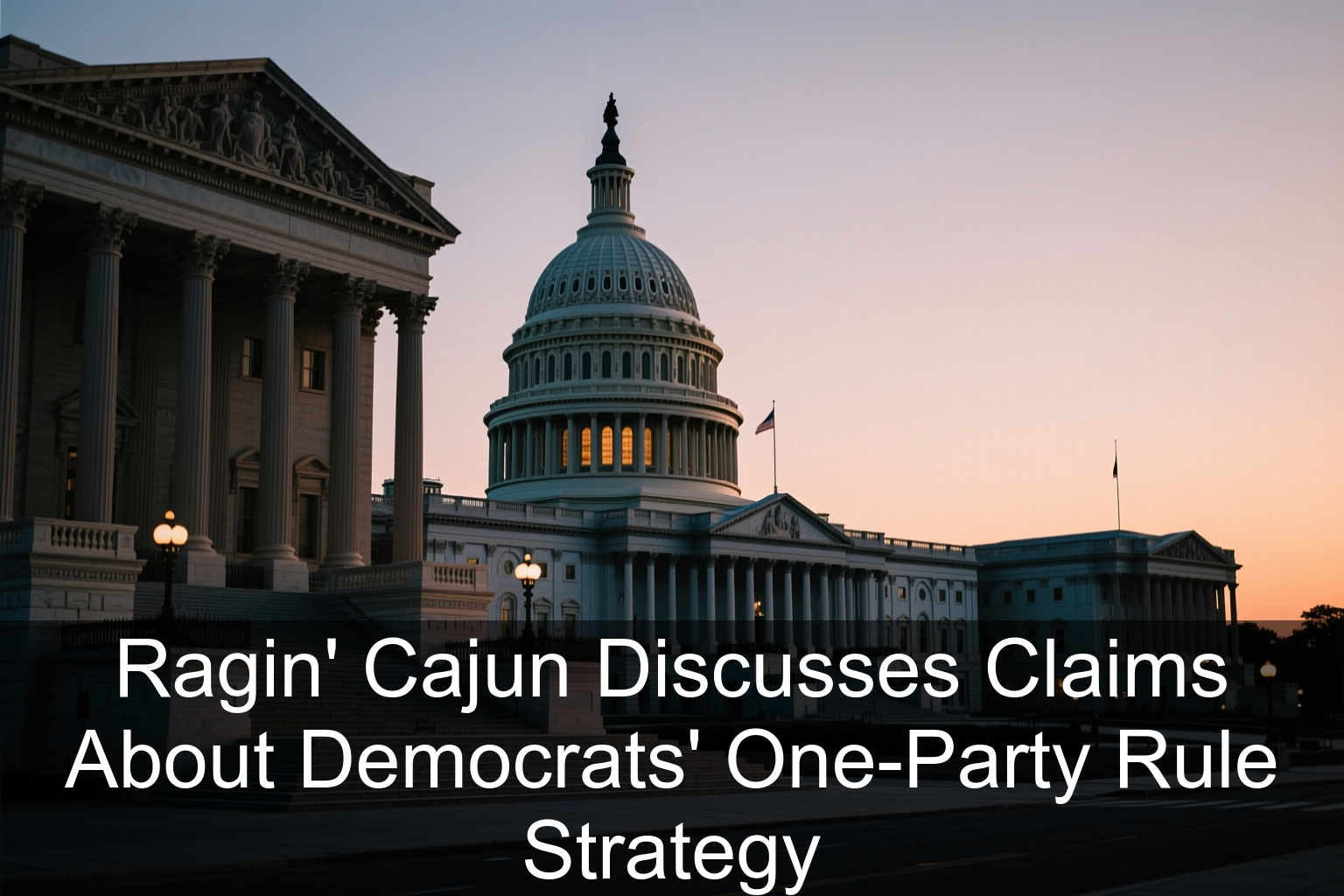
James Carville, the longtime Democratic strategist known as the “Ragin’ Cajun” and a former adviser to President Bill Clinton, is drawing fresh attention today after laying out what critics are calling a blueprint for Democrats to lock in lasting power if they regain unified control of Washington next year.
The comments being circulated come from a recent argument Carville made about what Democrats should do if they win back both chambers of Congress. In that scenario, he said Democrats should act immediately to grant statehood to Washington, D.C., and Puerto Rico—an outcome that would add four new U.S. Senate seats. He also argued for expanding the U.S. Supreme Court to 13 justices.
Carville’s framing wasn’t limited to the policy proposals themselves. The line now being cited as the core of the “one-party rule” interpretation is his advice about messaging: he urged Democrats not to campaign on the plan and not to publicly debate it ahead of time, instead pushing for swift action after the election. In his words: “Don’t run on it. Don’t talk about it. Just do it.”
Those remarks are now being presented by opponents as a strategy built around winning first and formalizing structural changes later—especially changes that would reshape two institutions central to federal power: the Senate and the Supreme Court.
How this is being framed as a “one-party rule” playbook
Supporters of Carville’s approach describe it as hardball politics and a response to long-running fights over representation and the courts. Critics frame it differently: they argue that adding states to change the Senate’s partisan balance and increasing the number of justices to shift the Supreme Court’s direction would amount to institutional redesign for partisan advantage.
The underlying mechanics are not in dispute. Congress has the authority to admit new states under Article IV, Section 3 of the Constitution. Congress also sets the size of the Supreme Court; the current structure is one chief justice and eight associate justices.
Court expansion, in particular, has been part of national political debate in recent election cycles. Carville’s comments revive that debate now, with critics contending that a larger court would be used to produce outcomes aligned with Democratic priorities—including, in this framing, decisions less protective of Second Amendment claims.
What Democratic officials involved are saying right now
At the moment, Carville is not speaking as an officeholder, and the proposals he raised—D.C. statehood, Puerto Rico statehood, and Supreme Court expansion—are not new concepts in Democratic politics. But his blunt instruction to avoid campaigning on the plan is what is intensifying the political reaction today, as opponents argue it signals a willingness to pursue sweeping changes without first making the case directly to voters.
As debate over these ideas continues in real time, Democratic leaders who support statehood initiatives generally argue that statehood is a question of democratic representation rather than party advantage. Likewise, officials and candidates who have discussed Supreme Court changes typically present their arguments as court reform, while critics interpret the same proposals as court packing.
Why this matters in the current policy fight
For gun policy advocates watching the 2026 landscape, the dispute isn’t just about abstract governance. The argument being made by opponents of Carville’s approach is that structural power determines policy outcomes: if Senate math changes and the Supreme Court changes, then major federal policy shifts become easier to pass and harder to overturn.
That concern is being tied to ongoing state-level action. In Virginia, Gov. Abigail Spanberger is currently weighing what to do next after SB 749 was sent to her by the legislature. The bill would ban purchases of many Modern Sporting Rifles (MSRs), semiautomatic shotguns commonly used for hunting and home defense, many pistols, and standard-capacity magazines. Spanberger previously pledged during her campaign to pursue strict gun control, and the situation has prompted increased firearms purchasing in Virginia as residents act before any new restrictions take effect.
Critics argue that what is happening in Virginia offers a preview of what could follow at the federal level if Democrats gain the ability to move major legislation and shape the courts reviewing it. The list of federal priorities they cite includes bans on semiautomatic rifles, confiscation proposals, bans on popular handguns, repealing the Protection of Lawful Commerce in Arms Act (PLCAA), requiring universal background checks, creating a federal gun ownership registry, banking policies that could restrict financial services to the industry, and bans affecting traditional ammunition.
Carville’s quote, and why it’s driving headlines
Carville’s remarks are being replayed because they combine a specific set of structural proposals with an unusually direct political instruction about timing and public messaging. In a longer statement that’s now widely quoted, he said: “If the Democrats win the presidency and both houses of Congress, I think on day one, they should make Puerto Rico [and] D.C. a state, and they should expand the Supreme Court to 13. *expletive* Eat our dust,” he said.
Whether voters view that as practical political strategy or as an attempt to engineer durable advantage is now a central part of the story. Either way, the comments are giving new energy to debates about statehood, Supreme Court size, and how openly major institutional changes should be campaigned on before Election Day.