

firearms

  • Georgia Groom Aaron White Has Charges Dropped in 2024 Wedding-Night Shooting of Bride’s Stepfather

    Georgia Groom Aaron White Has Charges Dropped in 2024 Wedding-Night Shooting of Bride’s Stepfather

    Prosecutors in Henry County, Georgia, have ended the criminal case against Aaron White, the groom who was accused of fatally shooting his bride’s stepfather on the night of their wedding in 2024. The murder and aggravated assault counts filed against White have been formally dismissed, bringing the prosecution to a close.

    The man who died was identified as Jason Maughon, the bride’s stepfather. White’s legal defense centered on self-defense, and that claim became the key issue the state would have needed to overcome to continue pursuing a conviction.

    The Henry County District Attorney’s office, which assumed control of the matter after allegations of forensic misconduct under the prior administration, reviewed the evidence and the posture of the case. After taking over, prosecutors concluded the available proof did not allow them to move forward on the charges under the required legal standards.

    According to the prosecutors’ assessment, they could not negate White’s claim that he acted to protect himself. They also determined they could not establish beyond a reasonable doubt that White was the primary aggressor in the confrontation, a finding that undercut the state’s ability to prove the criminal allegations in court.

    With the dismissal now entered, White is no longer facing the murder and aggravated assault charges stemming from the wedding-night shooting. The decision underscores how, in a case involving a self-defense assertion, the government must meet a high burden of proof—and when that burden cannot be met, charges should not proceed.

  • DOJ’s Missing Gun Rights Restoration Path Leaves Law-Abiding Americans in Limbo

    DOJ’s Missing Gun Rights Restoration Path Leaves Law-Abiding Americans in Limbo

    The Department of Justice has produced a new development tied to the restoration of gun rights, but it is not the outcome many Second Amendment advocates have been anticipating. For activists focused on a clear, workable way for people to regain firearm rights after losing them under federal law, the latest signal from DOJ does not appear to deliver that long-awaited plan.

    At the center of the frustration is the question of when, or whether, DOJ will put forward a functional rights-restoration mechanism that people can actually use. Supporters of gun rights have been watching for a concrete policy or procedure that would allow qualified individuals to have their rights recognized again. Instead, the update that exists does not match the type of forward movement many expected to see.

    The situation matters because, in practice, “rights restoration” is not an abstract talking point—it affects real people who believe they should have a defined process to regain constitutionally protected liberties once they have satisfied legal penalties or otherwise become eligible. From a libertarian and conservative perspective, a system that removes a fundamental right should not be allowed to operate indefinitely without an accessible, predictable route to restoration.

    The new information indicates DOJ activity in the area, yet it still leaves unanswered the basic question raised by gun-rights proponents: where is the actual restoration plan? Without a clear program, timelines, or public-facing standards, the promise of restoring rights can feel more like a concept than a functioning part of the justice system.

    For those following the issue, the takeaway is that DOJ’s recent movement does not appear to provide the specific relief many advocates have demanded. Until the department puts a usable, transparent framework in place, the debate is likely to continue—especially among Americans who see the Second Amendment as a core civil liberty that should not be treated as permanently forfeited without a fair path back.

  • Best Beginner Concealed Carry Handgun: How to Choose a Safe, Reliable First Pistol

    Best Beginner Concealed Carry Handgun: How to Choose a Safe, Reliable First Pistol

    Choosing a first concealed-carry handgun is less about chasing a trend and more about picking a tool you can operate confidently, carry responsibly, and practice with regularly. For new gun owners, the goal is straightforward: find a pistol that works every time, is comfortable enough to keep on you, and is manageable to shoot so training doesn’t become a frustrating chore.

    Reliability should sit at the top of the list. A carry gun is meant to function when you need it, and beginners are best served by a dependable pistol that runs consistently with quality ammunition and basic maintenance. Alongside that, a beginner-friendly option is one that you can handle well at the range—something controllable in recoil and easy to manipulate—because consistent practice is what builds safe habits and competent marksmanship.

    Safety and day-to-day carry considerations matter just as much as how the gun performs on the firing line. A pistol that is simple to carry securely and safely will be easier to integrate into your routine, which is the entire point of concealed carry. The best option for a new carrier is one that supports careful handling, encourages ongoing training, and fits a responsible approach to personal defense and self-reliance.

    Rather than treating “best” as a single model, the practical approach is to focus on what makes a handgun appropriate for a beginner: a proven track record, shootability that supports learning, and a design you can carry with confidence. If the gun is uncomfortable, difficult to control, or intimidating to operate, many people will avoid practice or stop carrying altogether—both outcomes undermine the purpose of owning it.

    Ultimately, the right concealed-carry handgun for a beginner is the one you can safely manage, comfortably conceal, and commit to training with over time. A clear-eyed selection process—prioritizing reliability, ease of shooting, and safe carry—helps new gun owners make a responsible choice while reinforcing the principle that personal protection is an individual right best exercised with competence and discipline.

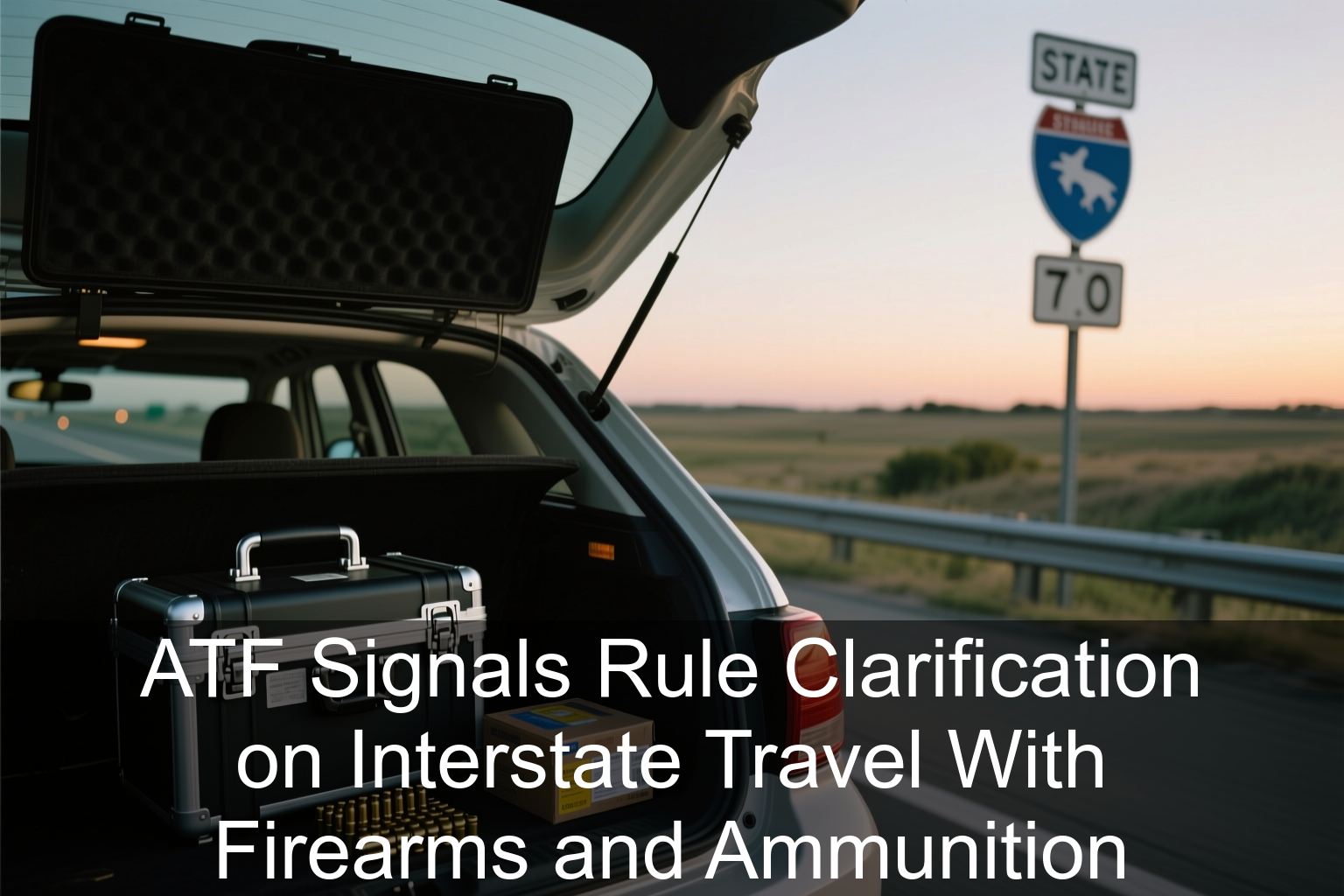
  • ATF Signals Rule Clarification on Interstate Travel With Firearms and Ammunition

    ATF Signals Rule Clarification on Interstate Travel With Firearms and Ammunition

    Federal officials are taking steps to spell out how gun owners can legally move firearms and ammunition from one state to another, an issue that often leaves travelers guessing about where federal protections begin and where state restrictions might create risk.

    The Bureau of Alcohol, Tobacco, Firearms and Explosives (ATF) is looking at changes intended to make the rules clearer for people who are transporting guns across state lines. The focus is on how firearms and ammunition can be carried during travel, particularly when a trip involves passing through multiple jurisdictions with different local laws.

    Supporters of broader gun-rights protections have long argued that lawful owners should not have to navigate a patchwork of conflicting regulations simply to travel. From a libertarian and conservative perspective, clearer federal guidance can reduce the likelihood that otherwise law-abiding citizens become entangled in legal trouble due to misunderstandings or unclear standards.

    At the center of the effort is the federal government’s stated goal of clarifying what constitutes lawful transport while traveling. That includes addressing common situations encountered on the road, such as crossing state borders with a firearm and ammunition stored as part of a trip.

    The ATF’s move reflects an attempt to define the contours of protected interstate transport in a way that is easier to understand and apply. For gun owners who travel, any additional clarity from federal regulators could be consequential, especially in states where firearm rules differ sharply from those in neighboring jurisdictions.

  • ATF Signals Rule Clarification on Interstate Travel With Firearms and Ammunition

    ATF Signals Rule Clarification on Interstate Travel With Firearms and Ammunition

    Federal officials are taking steps to spell out how gun owners can legally move firearms and ammunition from one state to another, an issue that often leaves travelers guessing about where federal protections begin and where state restrictions might create risk.

    The Bureau of Alcohol, Tobacco, Firearms and Explosives (ATF) is looking at changes intended to make the rules clearer for people who are transporting guns across state lines. The focus is on how firearms and ammunition can be carried during travel, particularly when a trip involves passing through multiple jurisdictions with different local laws.

    Supporters of broader gun-rights protections have long argued that lawful owners should not have to navigate a patchwork of conflicting regulations simply to travel. From a libertarian and conservative perspective, clearer federal guidance can reduce the likelihood that otherwise law-abiding citizens become entangled in legal trouble due to misunderstandings or unclear standards.

    At the center of the effort is the federal government’s stated goal of clarifying what constitutes lawful transport while traveling. That includes addressing common situations encountered on the road, such as crossing state borders with a firearm and ammunition stored as part of a trip.

    The ATF’s move reflects an attempt to define the contours of protected interstate transport in a way that is easier to understand and apply. For gun owners who travel, any additional clarity from federal regulators could be consequential, especially in states where firearm rules differ sharply from those in neighboring jurisdictions.

  • Jury Acquits Mansoor Ali in Cheyenne King Soopers Parking Lot Shooting Case

    Jury Acquits Mansoor Ali in Cheyenne King Soopers Parking Lot Shooting Case

    A Laramie County jury has returned not-guilty verdicts for Mansoor Ali, closing a closely watched case tied to a deadly encounter outside a King Soopers in Cheyenne. Ali, 22, had been on trial in connection with the shooting death of 19-year-old Benjamin Glenn.

    Jurors cleared Ali of second-degree murder, rejecting the prosecution’s claim that the shooting met the elements of that offense. In addition to the homicide charge, the panel also found Ali not guilty on four counts of aggravated assault and battery.

    The case centered on what occurred in the grocery store’s parking lot, where Glenn approached Ali while armed with a firearm. Ali’s defense team argued that the situation presented an immediate threat and that Ali’s decision to shoot was a lawful act of self-defense.

    The verdict followed a high-profile trial that drew significant attention because it involved competing narratives about danger, decision-making in tense moments, and the legal boundaries of defensive force. Ultimately, the jury accepted the self-defense argument offered by Ali’s attorneys.

    For many observers who prioritize individual rights and the principle that citizens should not be punished for protecting themselves when faced with an armed threat, the outcome reinforces the importance of due process and the right to self-defense. With the acquittal on all listed charges, Ali leaves the courtroom without criminal convictions from this incident.