firearm policy

  • New York Bill Would Restrict BB and Pellet Guns

    New York Bill Would Restrict BB and Pellet Guns

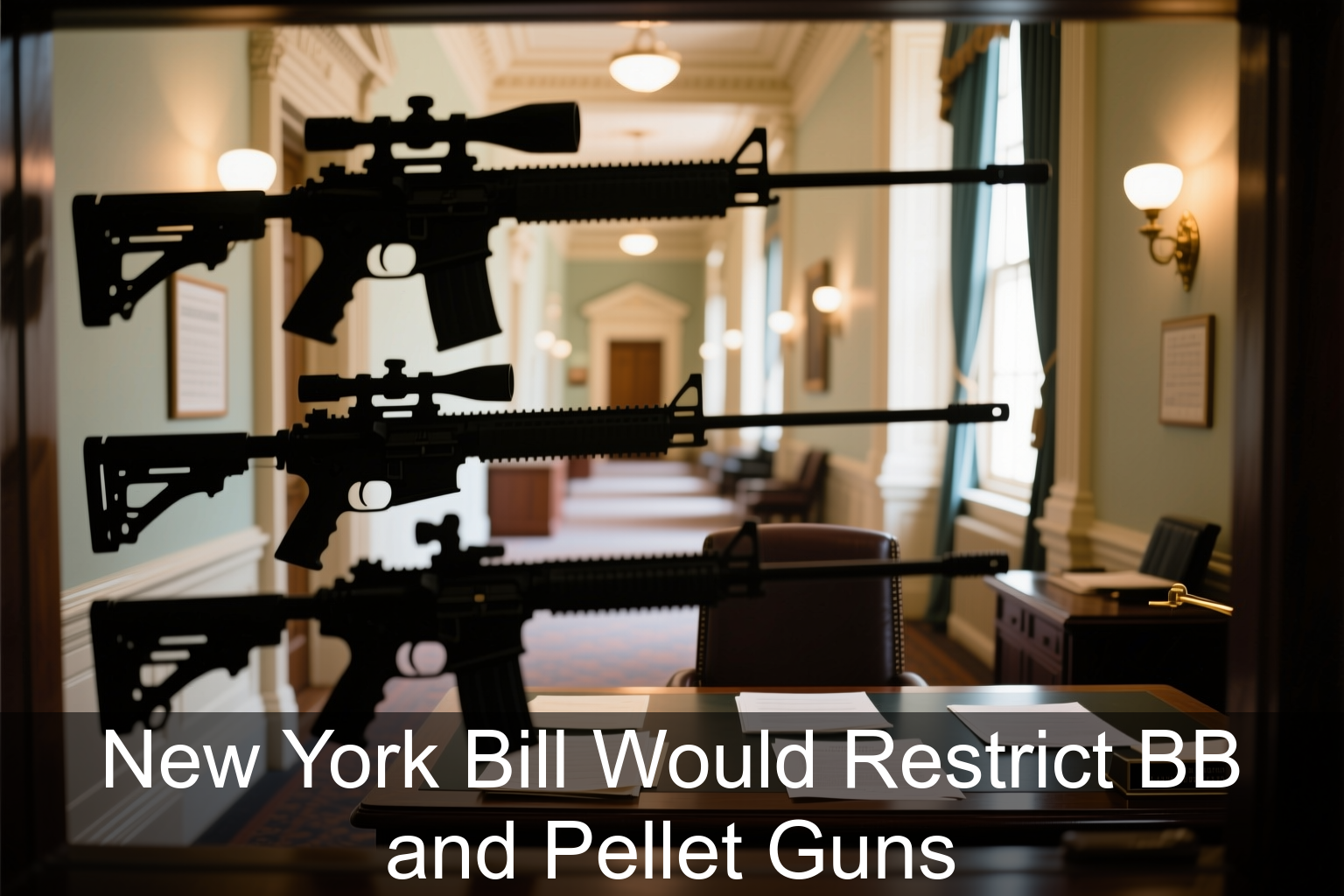
    Albany is weighing a pair of bills that would change how BB guns, pellet guns, and air rifles are treated under New York law—and the next steps in the Capitol will determine whether these common recreational items become regulated like non-firing replicas.

    Right now, the proposal is moving through the State Legislature under two companion measures: A10701 in the Assembly and S9215 in the Senate. Both bills target a single, high-impact change: expanding the state’s definition of an “imitation weapon” so it would also cover functional air guns, including BB guns, pellet guns, and air rifles.

    That definitional shift matters because New York’s current rules for “imitation weapons” weren’t built for devices that actually fire a projectile. Under existing law, an imitation weapon is something designed to resemble a real firearm but that is not a firearm. To be sold legally, products in that category must meet five requirements: they must be made from transparent or brightly colored material, they must display the manufacturer’s name, they cannot include a laser pointer, and—most crucially—the barrel has to be sealed with a plug at least one-half inch deep.

    If BB and pellet guns are reclassified into that category, retailers would be pushed into an immediate compliance problem. A functional air gun depends on an open barrel to operate; a mandated plug would block it. In practical terms, stores could only sell versions that have been rendered incapable of firing—turning what is typically purchased for target practice, basic shooting-safety familiarity, and pest control into an inert look-alike.

    For current owners, the bills are aimed at sales and classification rather than announcing a direct confiscation in the details available here, but the ripple effects could still be substantial. If the market shifts to “imitation weapon”-compliant designs, replacement options, parts availability, and future purchases in New York could narrow sharply. The biggest day-to-day consequence would land on anyone who expects to buy a working air rifle or BB gun in-state going forward.

    The bills also reach beyond product design by changing who counts as part of the regulated industry. The proposal would treat manufacturers of these air guns as “gun industry members.” That matters because it would expose them to New York’s nuisance-law framework, creating a path for civil lawsuits similar to those faced by manufacturers of traditional firearms. Supporters frame that as accountability; opponents argue it could make the New York market unattractive enough that manufacturers simply stop selling there.

    There’s also active discussion of revisions. An amendment has been floated that focuses in part on paint pellet guns, but it would add its own set of practical changes: raising the minimum purchase age from 16 to 18 and increasing penalties for violations by a factor of two. Whether that amendment advances, and how it’s ultimately written, will shape what retailers must check at the counter and what compliance would look like for stores that currently sell these products.

    For now, the immediate path is straightforward but consequential: A10701 and S9215 must continue through the normal Albany process—committee consideration, floor action in each chamber, and then alignment between the Assembly and Senate versions before anything could reach the governor. Until that happens, nothing changes on store shelves. But if the reclassification becomes law, the plugged-barrel requirement alone would likely redefine what “legal to sell” means for BB guns, pellet guns, and air rifles across New York.

    Safety reminder as this debate plays out: treat every firearm and air gun as though it’s loaded, and never point one at anything you are not willing to destroy—air rifles and BB guns can still cause serious injury.

  • Virginia Gun Control Bill Nears Final Form After Legislature Rejects Governor’s Key Change

    Virginia Gun Control Bill Nears Final Form After Legislature Rejects Governor’s Key Change

    Virginia’s gun-control package is now close to its endgame after lawmakers turned aside several of Gov. Abigail Spanberger’s most consequential requested edits, a decision that narrows what will change immediately and clarifies what still hinges on her next move.

    The turning point came Wednesday, when the Democratically controlled Senate and House of Delegates voted on multiple recommendations Spanberger sent back to them. Virginia’s process gives the governor unusual leverage at this late stage, allowing her to propose alterations after bills have already cleared the General Assembly. This week’s votes show that leverage has limits when the legislature isn’t willing to expand a bill beyond what it originally passed.

    The biggest practical effect of the rejection involves ammunition magazines. Spanberger had pushed for a tighter approach that would have functioned as a carry ban on magazines capable of holding more than 15 rounds. Lawmakers declined to adopt that change, meaning the final version won’t include that added restriction she sought.

    Legislators also refused another significant request tied to the new ban on guns in mental health hospitals. The governor wanted to remove an exception included by the legislature, but the House and Senate voted against stripping it out. As a result, the exception remains part of the bill that’s heading back to the executive branch.

    Even with the governor’s preferred expansions blocked, the overall scope of Virginia’s 2026 gun policy changes remains large. As of this week, 11 new gun-control bills have already completed the legislative process to the point that they’ve “made it across the finish line,” though two of the most far-reaching measures are still, at least technically, unresolved.

    Now, the measures lawmakers declined to amend return to Spanberger’s desk. From here, she has three options on each bill: sign it, veto it, or do nothing and allow it to become law without her signature. Those choices will determine not only which restrictions take effect, but also how quickly Virginia’s new rules solidify after a session that’s already produced the state’s biggest shift in gun policy in a long time.

  • Virginia Lawmakers Reject Gov. Spanberger’s Proposals on Magazine Limits and Hospital Gun Ban

    Virginia Lawmakers Reject Gov. Spanberger’s Proposals on Magazine Limits and Hospital Gun Ban

    Virginia’s gun policy agenda is moving again, but Governor Abigail Spanberger is finding that a Democratic legislature won’t automatically follow her lead on the most aggressive changes.

    Right now, the Senate and House of Delegates have voted down several recommendations Spanberger sent back during a special session, blocking two major moves she wanted: a tougher approach to ammunition magazine restrictions and a stricter ban on firearms in certain hospital settings. With those recommendations rejected, the underlying bills return to the governor in their original form, leaving Spanberger with a narrow set of options—sign, veto, or take no action and allow them to become law.

    The flashpoint on magazines centers on Spanberger’s effort to create what would effectively function as a ban on carrying magazines holding more than 15 rounds. Lawmakers had already advanced their own proposals, but her requested changes would have gone further. By refusing her edits, both chambers undercut that approach, particularly her attempt to use changes to the definition of “assault firearm” in the sales-ban measures HB217 and SB749 as part of a broader strategy. While lawmakers did accept her amendments to the separate “assault firearm” carry-ban bills HB1524 and SB727, they declined to adopt her alterations to the sales-ban definition, which breaks the pathway she was trying to build to restrict magazine carry beyond what the legislature had originally written.

    Hospitals became the other major point of contention. Spanberger tried to tighten HB229, which bars guns at hospitals that provide mental health treatments. Her proposal would have removed exceptions covering people with written hospital authorization—including authorization connected to an employee’s job duties—and people brought to a hospital under an emergency custody order or an involuntary detention order. Legislators refused to remove those carveouts, leaving the bill’s existing exceptions intact.

    Even as these two high-profile requests failed, lawmakers did agree to Spanberger’s other firearms-related recommendations. They approved amendments to seven additional gun bills, including a change recognizing a gun lock as an acceptable way to comply with new safe storage rules and an adjustment to the state’s new voluntary “buy-back” program language, shifting the terminology to “sell-back.” Those measures are set to take effect July 1. One exception is the handgun ban for 18-to-20-year-olds; at Spanberger’s request, that measure was converted into an emergency enactment and takes effect immediately.

    Spanberger has framed her amendments as an effort to make the new laws workable in practice, clearer for gun owners and law enforcement, and aligned with constitutional limits. Her office also pointed to the prior four years, when many gun safety bills—including some that received bipartisan votes—were vetoed, arguing the current administration is moving to implement significant changes while trying to address real-world situations.

    But the legislature’s refusal to take her hardest-line edits is a visible sign of intra-party friction. It suggests that even with Democrats holding power, there are limits on how far leadership in Richmond is willing to go, or at least how far they are willing to go on Spanberger’s timeline and framing. It also puts Spanberger in a politically awkward place: she pushed for stricter versions, lost those fights, and now has to decide whether the bills as written still match her priorities well enough to approve.

    The decision is consequential because legal challenges are already being teed up. Gun-rights organizations in Virginia and nationally, including the National Rifle Association, have warned they are prepared to sue if Spanberger signs the new bans. The U.S. Department of Justice has also threatened litigation over the “assault firearms” ban. The NRA told its members it intends to challenge the bills immediately upon her signature and said it is watching closely as the measures return to her desk.

    Procedurally, the rejection of Spanberger’s changes to HB217, HB229, and SB749 means those bills now go back to her without the tougher language she requested. Under Virginia’s process, she can sign them, veto them, or allow them to become law without signing. She has 30 days to choose.

    That 30-day window is now the center of gravity. If Spanberger signs, she accepts legislation that doesn’t include some of the restrictions she publicly sought—while still inheriting the political and legal fallout that comes with the broader package. If she vetoes, she risks intensifying the perception that she and legislative leaders are not aligned, despite sharing the same party. And if she lets the bills become law without her signature, she may try to split the difference—permitting enactment while signaling she didn’t get the final product she wanted.

    Either way, the legislature has sent an unmistakable message: the governor can shape details at the margins, but when she pushes for the sharpest edge of gun regulation—like an effective magazine-carry ban or a hospital prohibition without key exceptions—Democratic lawmakers are willing to say no. The next move belongs to Spanberger, and it will reveal whether she’s prepared to own the compromises or escalate the fight with a veto.