
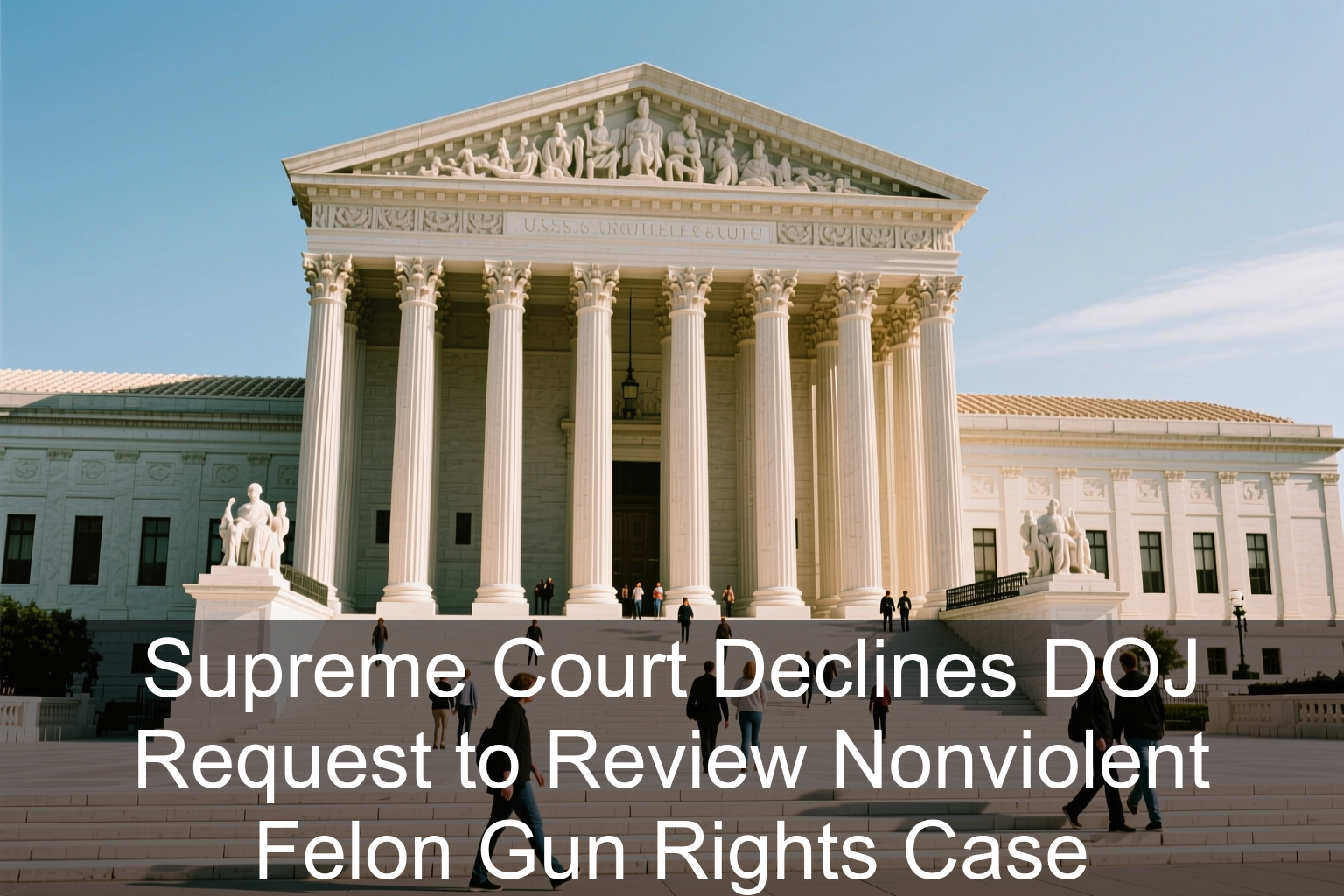

The U.S. Supreme Court has chosen not to take up a Justice Department appeal involving gun ownership rights for people with nonviolent felony convictions. The decision leaves unresolved, for now, a major constitutional and policy question that has been developing in the lower courts.
At the center of the dispute is a federal statute that broadly prohibits felons from possessing firearms. In the case at issue, a lower court had ruled that the ban could not be applied in full in the circumstances before it, partially invalidating the restriction as it related to nonviolent felons. The Justice Department asked the Supreme Court to step in and review that outcome.
By turning down the appeal, the justices signaled they are not yet prepared to provide nationwide guidance on how the Second Amendment applies to individuals convicted of nonviolent felonies. The practical effect is that the lower court’s ruling remains in place, but only within the bounds of that case and the jurisdiction where it applies.
The refusal to hear the case also means the broader legal debate continues without a definitive ruling from the nation’s highest court. For gun-rights advocates, this ongoing uncertainty matters because it leaves constitutional questions to be decided circuit by circuit, with outcomes potentially varying across the country.
From a conservative and libertarian perspective, the court’s decision highlights the ongoing tension between one-size-fits-all federal prohibitions and the principle that rights should not be curtailed beyond what is necessary—especially when the underlying conviction did not involve violence. Until the Supreme Court addresses the issue directly, the contours of gun rights for nonviolent felons will remain largely shaped by lower-court litigation.