
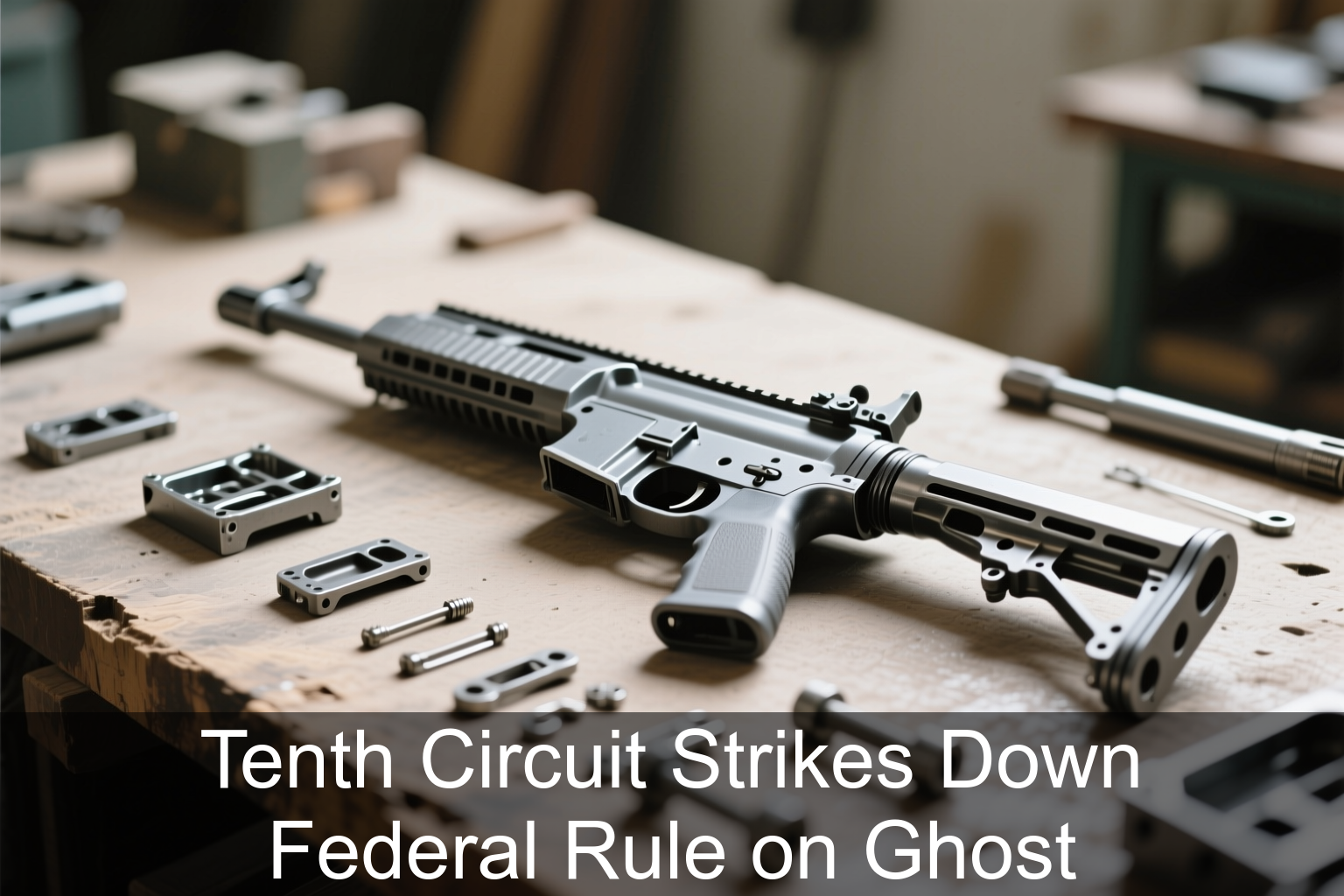

A major shift just landed for anyone dealing in “ghost gun” kits and unserialized frames or receivers across the Tenth Circuit. A three-judge panel of the U.S. Court of Appeals for the Tenth Circuit has struck down the federal ATF rule that attempted to regulate unfinished frames and receivers—often sold as parts kits—by treating many of them as firearms.
That ruling changes what the Bureau of Alcohol, Tobacco, Firearms and Explosives can enforce right now within the Tenth Circuit, even as the larger nationwide fight continues in other courts. For kit sellers, buyers, and compliance teams, the immediate question isn’t philosophical—it’s practical: what rules apply today, what has paused, and what still exposes you to risk.
What the decision does inside the Tenth Circuit
With the ATF’s unfinished frames and receivers rule knocked out in this region, the agency’s ability to rely on that rule as the basis for enforcement against qualifying kits is immediately constrained in Tenth Circuit states. That means the federal regulatory hook that many businesses adjusted to—treating certain kits like completed firearms for purposes such as serialization and licensed-dealer processing—no longer has the same force here.
If you sell kits: your compliance playbook may diverge by geography
For businesses that ship or sell firearm parts kits, this decision creates a real split in day-to-day compliance. Inside the Tenth Circuit, the ATF rule is no longer the controlling standard. Outside the Tenth Circuit, sellers still have to assume the federal rule may be enforced depending on the jurisdiction and the posture of ongoing litigation.
In practice, many sellers are now facing a choice:
1) Keep a single nationwide compliance standard (more conservative, easier operationally).
2) Run a Tenth Circuit-specific approach (potentially less burdensome here, but operationally complex and legally sensitive).
3) Pause certain product offerings or shipping destinations until the legal landscape stabilizes.
Even for sellers who want to loosen restrictions in Tenth Circuit states, the business risk doesn’t disappear. State laws and other federal statutes still matter, and this ruling does not guarantee that future appeals or other courts won’t bring different outcomes.
If you buy kits: federal treatment shifts here, but your state law still controls
For buyers in the Tenth Circuit, the biggest immediate impact is that the ATF can’t lean on the vacated federal rule to treat covered unfinished frames/receivers or parts kits as regulated firearms under that rule’s framework. But that doesn’t mean “anything goes.”
State and local restrictions can still prohibit certain conduct, and they can be broader than federal requirements. Colorado, for example, has its own restrictions aimed at unserialized frames, receivers, and firearms. Those state limits remain a separate legal layer, and the Tenth Circuit’s action on the federal rule doesn’t automatically cancel state bans.
ATF enforcement posture: narrower in the Tenth Circuit, but not frozen everywhere
The ruling restricts ATF’s ability to enforce the invalidated federal rule in the Tenth Circuit, but it doesn’t eliminate ATF authority generally. The agency can still pursue cases under other federal laws where applicable. The practical change is that the specific regulatory theory created by the unfinished frames and receivers rule is no longer available as a basis for enforcement here.
Meanwhile, ATF can still take a different posture in jurisdictions outside the Tenth Circuit, where the rule may remain in effect depending on ongoing litigation.
Why this matters beyond the federal rule: courts are scrutinizing “end-run” reasoning
This moment also arrives as courts continue to wrestle with how far governments can go in regulating possession, acquisition, and manufacture while claiming the Second Amendment isn’t implicated. In a separate Tenth Circuit case involving Colorado’s ban on unserialized firearms, frames, and receivers, the court rejected the idea that a possession ban can be treated as merely a condition on commercial sales. The panel emphasized that a prohibition on possessing an unserialized frame or firearm regulates possession regardless of how it was obtained.
That analysis signals something important for compliance planning: courts in this circuit are paying close attention to how laws are characterized, especially when governments argue that regulations affecting firearms fall outside the Second Amendment’s coverage.
Where things go next: regional reality now, national uncertainty later
This decision doesn’t end the broader dispute over how unfinished frames, receivers, and firearm parts kits should be treated under federal law. It does, however, create an immediate and concrete enforcement boundary within the Tenth Circuit.
For sellers, the operational question becomes whether to standardize compliance nationally or tailor it to a patchwork legal map. For buyers, the key takeaway is that federal regulatory treatment has shifted here—but state bans and other restrictions may still apply. For the ATF, this ruling narrows one pathway for enforcement in this circuit while leaving the agency to rely on other tools and to continue litigating in other regions.
Until the wider litigation resolves, the most realistic posture in the Tenth Circuit is cautious flexibility: understand what the ruling changes today, document your compliance decisions, and be prepared to adjust quickly if a higher court or another proceeding reshapes the rules again.