The Justice Department is taking a meaningful step toward easing federal marijuana controls, but it’s also making clear that the change does not automatically translate into near-term relief for marijuana users who possess firearms—especially in the Supreme Court fight now pending in US v. Hemani.
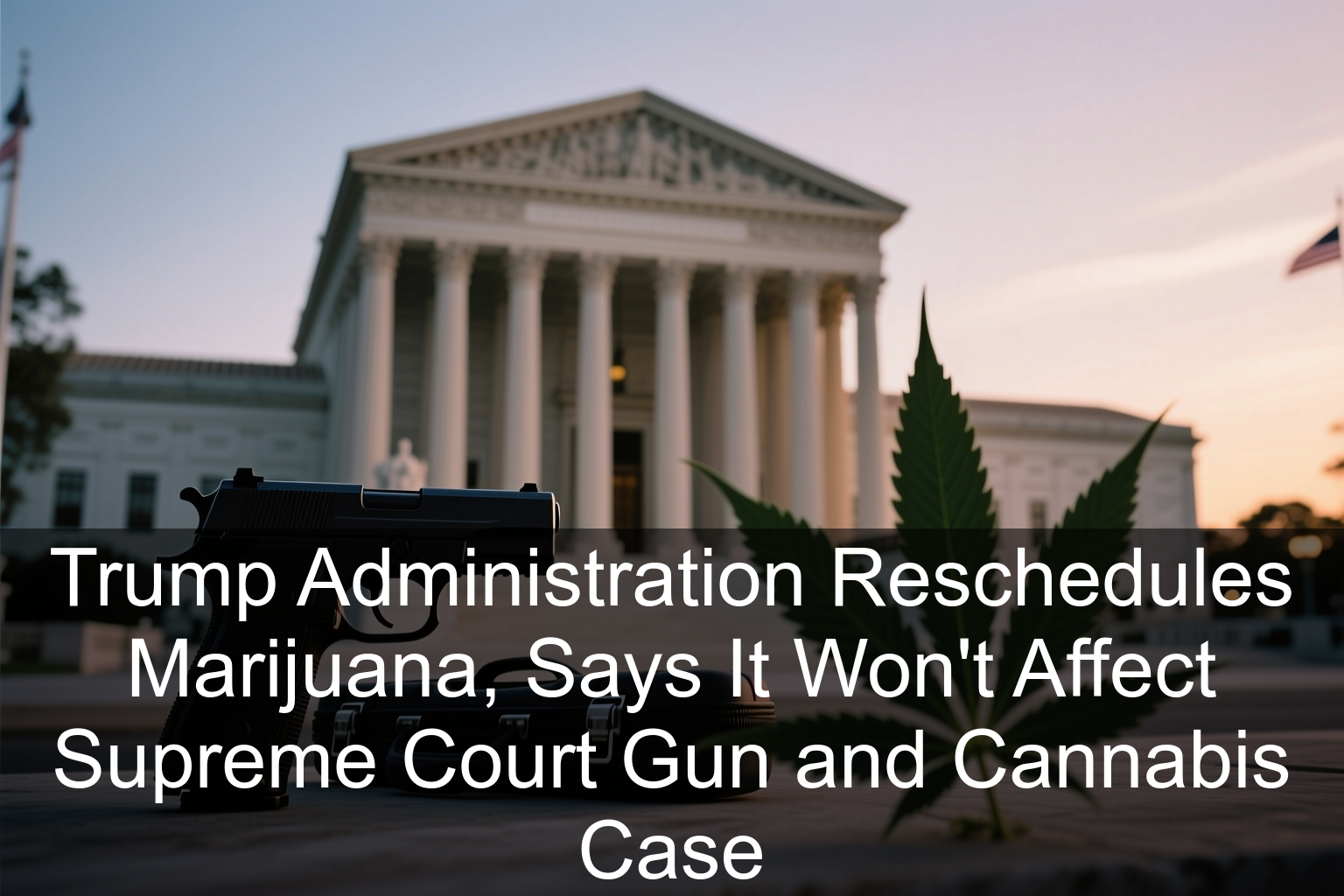
On Thursday, DOJ issued a final order that moves marijuana to a less restrictive status under the federal scheduling system and expands the set of circumstances in which marijuana-related products can be used lawfully. At the same time, Solicitor General John Sauer notified the Supreme Court that, in the administration’s view, the new scheduling decision should not alter how the justices resolve Hemani’s challenge to the federal ban on gun possession by certain drug users.
Sauer’s message to the Court is straightforward: the government does not believe the rescheduling order changes the legal questions in Hemani in a way that requires a different outcome. The case involves a man charged after agents recovered a firearm from his home and he acknowledged using marijuana multiple times per week. DOJ is continuing to defend its ability to enforce the gun prohibition in at least some marijuana-related scenarios.
What the new DOJ order does—and what it does not do—matters for anyone trying to understand how enforcement may look in the months ahead.
The order relaxes restrictions, but it does not create blanket federal legalization. Instead, DOJ describes the change as applying broadly to marijuana and marijuana derivatives regulated under the Controlled Substances Act, including marijuana extracts and delta‑9‑tetrahydrocannabinol, as well as other marijuana-plant-derived compounds (excluding mature stalks and seeds) that are not considered hemp. Critically, DOJ ties the practical scope of the order to specific channels: the marijuana-related substances must be part of an FDA-approved drug product or must fall under a state-issued license that authorizes manufacturing, distribution, or dispensing for medical purposes (a “state medical marijuana license”). The order also places those drugs onto the list of substances that can be imported or exported only with a permit.
From an enforcement perspective, this structure suggests a potential narrowing of the highest-risk category of federal scrutiny for certain medical use pathways. It also hints at how the administration may want to draw lines between medical and recreational use when deciding where to direct resources. But the rescheduling action still leaves major constraints in place for gun owners.
The main reason is that the federal firearms prohibition at issue—18 U.S.C. § 922(g)(3)—does not hinge on whether marijuana is placed in Schedule I or Schedule III. The statute bars gun and ammunition possession by anyone who is an “unlawful user of or addicted to any controlled substance.” It does not distinguish between drugs across schedules, and it does not include an exception simply because a state has legalized marijuana. The relevant federal question is whether the substance remains federally controlled and whether the individual’s use is unlawful under federal law.
That’s why the administration can simultaneously ease certain federal marijuana rules and still argue that § 922(g)(3) remains enforceable against some marijuana users who have firearms.
The reaction from gun-rights advocates has been optimistic. Some activists are treating the scheduling move as a practical shield for gun owners who use medical marijuana consistent with state law, predicting fewer prosecutions and less fear of being categorized as a prohibited person.
The firearm industry, however, is signaling caution. When President Donald Trump floated the rescheduling plan late last year, the National Shooting Sports Foundation advised members not to change how they handle firearm sales based on the proposal—at least not until the legal and regulatory picture became clearer. The group’s compliance messaging stressed that marijuana users can still be treated as prohibited persons under § 922(g)(3), that state legalization does not change the federal analysis, and that possession of a state medical marijuana card should be viewed as evidence of unlawful use for purposes of the gun-ban statute.
DOJ’s Supreme Court filing in Hemani reinforces that the government is not backing away from the prosecution posture in that case. Sauer’s letter emphasizes two reasons the final order should not disrupt Hemani.
First, the government points to timing: in its view, Hemani’s criminal exposure depends on the law in effect when the alleged offense occurred, not on later regulatory changes. At the time of the charged conduct, marijuana remained a Schedule I substance.
Second, Sauer argues that even under the new final order, Hemani’s marijuana use would not be covered by the rescheduling’s practical carve-outs because the marijuana involved was not part of an FDA-approved product and was not within a state medical marijuana licensing framework. Under that understanding, the government maintains that Hemani’s conduct would still fall on the Schedule I side of the line anyway.
The Supreme Court’s questioning at oral argument last month suggests that several justices are not entirely comfortable with the government’s theory—particularly the suggestion that ordinary marijuana use reliably maps onto dangerousness in a way that justifies disarmament. Justice Amy Coney Barrett’s questioning captured the issue directly by pressing for evidence that using marijuana a couple of times per week makes someone dangerous, and by probing whether the government’s logic would extend to unlawful use of other prescription drugs such as Ambien or Xanax.
In his follow-up to the Court, Sauer also floated a potential off-ramp for the justices: if they want to avoid addressing how § 922(g)(3) applies to medical marijuana in a post-rescheduling world, they could craft a narrower decision focused only on Schedule I marijuana and leave the constitutionality of the statute as applied to Schedule III marijuana for another case.
For now, the operational takeaway is that DOJ’s rescheduling order may open additional lawful avenues for marijuana-related products in specific regulated settings, and it may change the political and practical context for some future enforcement decisions. But it does not, by itself, rewrite § 922(g)(3), nor does it persuade the administration to abandon its defense of that statute in US v. Hemani. Gun owners who use marijuana—especially outside FDA-approved channels or state medical licensing—should assume federal risk remains until courts or Congress change the underlying firearms law.
The Supreme Court is expected to issue its Hemani decision by the end of June.