ATF

  • Brady Sues DOJ and ATF to Revive Public “Name-and-Shame” Effort

    Brady Sues DOJ and ATF to Revive Public “Name-and-Shame” Effort

    Brady: United Against Gun Violence has taken legal action aimed at pressuring the federal government to restart a public-facing “name-and-shame” approach that it says should be supported by official agencies. The group’s lawsuit targets the U.S. Department of Justice and the Bureau of Alcohol, Tobacco, Firearms and Explosives, after the organization lost what it viewed as federal backing for the campaign.

    At the center of the dispute is Brady’s effort to publicly spotlight certain federally licensed firearms businesses. According to the account of the case, Brady wants the DOJ and ATF to provide information in a way that would enable continued public call-outs of specific industry participants, even though the agencies are constrained by federal legal requirements governing what can and cannot be disclosed.

    The legal complaint, as described, seeks to compel the agencies to act in ways critics argue would conflict with federal law. Those critics maintain that the requested disclosures are not simply a policy choice, but an attempt to force government offices into releasing material that statutes restrict, raising concerns about whether the suit is effectively asking the agencies to disregard existing rules.

    Beyond the legal questions, opponents of the lawsuit argue that expanding disclosures could create practical risks for public safety. They contend that exposing certain law-enforcement-sensitive details or operationally relevant information could endanger officers and ongoing work, and that government should not be pushed into making releases that could be exploited or that could compromise safety.

    From a conservative and libertarian perspective, the lawsuit is seen as an effort to use government power to amplify political pressure rather than to improve public safety through lawful, transparent processes. Critics argue that policy fights should not be waged by trying to force federal agencies into legally questionable actions, especially when those actions could create unintended consequences for law enforcement and the public.

  • Public Comment Urged as ATF Faces Accusations of Building an Unlawful Gun Registry

    Public Comment Urged as ATF Faces Accusations of Building an Unlawful Gun Registry

    A new call is circulating among gun-rights advocates urging Americans to weigh in during a public-comment period over allegations that the Bureau of Alcohol, Tobacco, Firearms and Explosives is effectively constructing a firearms registry outside the limits set by federal law. Supporters of the effort argue that a centralized record of lawful gun ownership would be incompatible with privacy, due process, and the constitutional boundaries placed on executive agencies.

    The push centers on encouraging individuals to submit comments aimed at stopping what critics describe as an “illegal registry.” In this view, the issue is not merely administrative recordkeeping, but the long-term consequences of government aggregation of sensitive personal data tied to lawful conduct. Advocates emphasize that even if records begin as routine paperwork, large-scale collection can become a de facto registry when data is preserved, organized, and made searchable.

    From a conservative and libertarian perspective, the dispute reflects a broader concern about federal agencies expanding their reach through regulation and internal procedures rather than through clear authorization from Congress. Critics argue that policy choices with major implications for civil liberties should be made through the legislative process, not through administrative actions that are difficult for ordinary citizens to track and challenge.

    Those promoting public participation say comments are a practical way for citizens to register opposition, create an official record of objections, and signal that voters are paying attention. They also argue that sustained public scrutiny can limit agency overreach by increasing political and legal accountability, especially when the subject involves constitutionally protected rights.

    The organizing effort is being publicized by Gun Owners of America, which is directing readers to its post on the issue, titled “Comment Now To Stop the ATF’s Illegal Registry!” The group is using the moment to encourage immediate civic engagement and to frame the controversy as a timely decision point for anyone concerned about the growth of federal power and the protection of Second Amendment rights.

  • ATF Pushes New “Streamlined” Gun Purchase Process, Raising Privacy and Due-Process Concerns

    ATF Pushes New “Streamlined” Gun Purchase Process, Raising Privacy and Due-Process Concerns

    A federal effort now underway could reshape how many Americans complete a firearm purchase, with changes likely to be noticeable at the gun counter. The initiative centers on the Bureau of Alcohol, Tobacco, Firearms and Explosives (ATF) and its push to make the buying process faster and more uniform.

    The ATF’s approach is being framed as a modernization and efficiency move—an attempt to reduce friction in the steps between selecting a firearm and finalizing a lawful transfer. Supporters of streamlining often argue that customers and dealers alike benefit when paperwork and delays are reduced.

    From a conservative and libertarian perspective, however, “streamlining” from Washington frequently comes with tradeoffs that deserve close scrutiny. When federal agencies redesign systems that touch constitutional rights, the details matter: how information is collected, how long it is retained, who can access it, and what new compliance burdens are quietly placed on lawful gun owners and small businesses.

    Another concern is that procedural changes can function like policy changes, even when Congress never votes on them. A shift in how purchases are processed can influence how easily people can exercise a fundamental right, and it can also expand the practical reach of federal oversight without transparent debate.

    The article from The Reload describes the effort as one that could alter the purchasing experience for most Americans in significant, visible ways. As this develops, gun owners and Second Amendment advocates are likely to watch whether the promised efficiency is achieved without building new back-end infrastructure that can be repurposed later for broader monitoring or restrictions.

    At minimum, any federal attempt to redesign the buying process should be judged by clear standards: protecting due process, preventing the creation of de facto registries, minimizing unnecessary data collection, and ensuring that lawful commerce is not choked by shifting administrative rules. If the ATF proceeds, the agency should be pressed to explain exactly what will change, why it is necessary, and how it will be constrained to avoid undermining the rights of ordinary Americans.

  • ATF Rule Changes and the Practical Impact on Gun Owners and FFLs

    ATF Rule Changes and the Practical Impact on Gun Owners and FFLs

    Federal firearms regulation is entering another adjustment period as the Bureau of Alcohol, Tobacco, Firearms and Explosives rolls out updated rules aimed at reshaping how oversight works for both Federal Firearms Licensees (FFLs) and everyday gun owners. The stated purpose is to increase openness and strengthen accountability in how the agency regulates the firearms marketplace. For many Americans who value limited government, the bigger question is whether these changes will function as genuine reform or simply expand bureaucracy under a new label.

    These rule updates focus heavily on the relationship between the ATF and license holders. FFLs sit at the center of lawful firearm commerce, and any regulatory shift tends to affect the entire system—from how transactions are handled to how compliance expectations are communicated and enforced. By presenting the changes as a move toward transparency, the agency signals that it intends to clarify standards and make oversight more consistent. Whether that clarity reduces uncertainty for businesses or creates additional administrative burdens will depend on how the rules are implemented in practice.

    Gun owners are also affected because the rules that govern licensees can ripple outward into the purchasing process, transfers, and the broader availability of lawful services. When policy changes alter how dealers operate, customers often experience the results through new procedures, longer timelines, or shifts in what businesses are willing to do to avoid compliance risks. Supporters of individual liberty typically want a system that targets actual criminal behavior while keeping lawful ownership and commerce straightforward and predictable.

    The reform framing suggests the ATF is attempting to address criticism about uneven enforcement and opaque decision-making. For conservatives and libertarians, accountability is not just a slogan—it should mean clear, stable rules that do not change depending on region, administration priorities, or internal interpretations that the public cannot easily evaluate. Transparency, in this sense, should include understandable guidance, consistent expectations, and a fair process that respects due process for licensees who are trying to comply in good faith.

    As these new rules take hold, FFLs and gun owners alike will be watching for the real-world effects: whether compliance becomes more manageable and predictable, or whether the regulatory footprint grows in ways that discourage lawful commerce. The outcome matters not only to businesses and customers, but also to the broader principle that constitutional rights should not be constrained by shifting administrative policy. The practical test will be whether the ATF’s promised transparency and accountability translate into measurable restraint and clarity rather than expanded red tape.

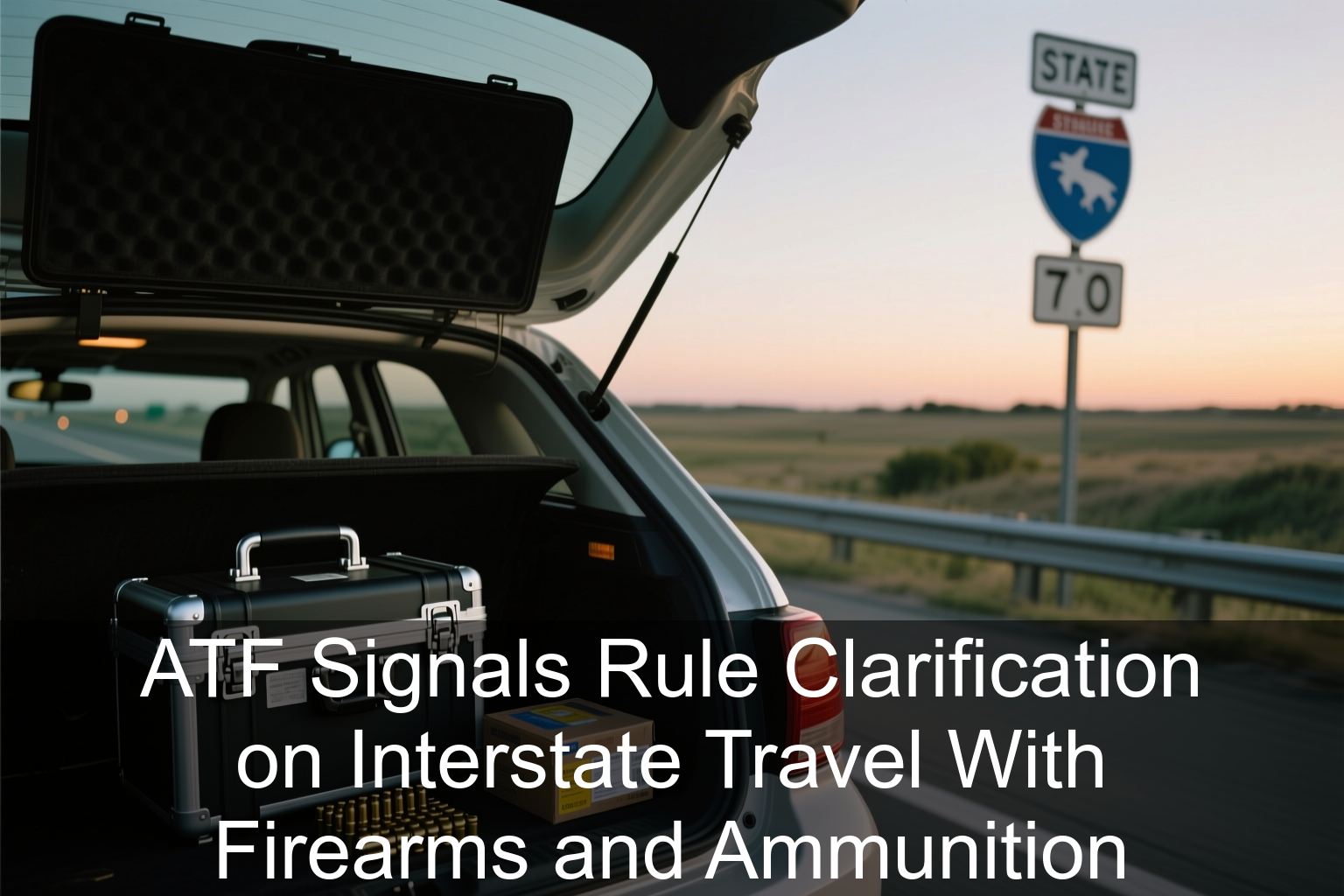
  • ATF Signals Rule Clarification on Interstate Travel With Firearms and Ammunition

    ATF Signals Rule Clarification on Interstate Travel With Firearms and Ammunition

    Federal officials are taking steps to spell out how gun owners can legally move firearms and ammunition from one state to another, an issue that often leaves travelers guessing about where federal protections begin and where state restrictions might create risk.

    The Bureau of Alcohol, Tobacco, Firearms and Explosives (ATF) is looking at changes intended to make the rules clearer for people who are transporting guns across state lines. The focus is on how firearms and ammunition can be carried during travel, particularly when a trip involves passing through multiple jurisdictions with different local laws.

    Supporters of broader gun-rights protections have long argued that lawful owners should not have to navigate a patchwork of conflicting regulations simply to travel. From a libertarian and conservative perspective, clearer federal guidance can reduce the likelihood that otherwise law-abiding citizens become entangled in legal trouble due to misunderstandings or unclear standards.

    At the center of the effort is the federal government’s stated goal of clarifying what constitutes lawful transport while traveling. That includes addressing common situations encountered on the road, such as crossing state borders with a firearm and ammunition stored as part of a trip.

    The ATF’s move reflects an attempt to define the contours of protected interstate transport in a way that is easier to understand and apply. For gun owners who travel, any additional clarity from federal regulators could be consequential, especially in states where firearm rules differ sharply from those in neighboring jurisdictions.

  • ATF Signals Rule Clarification on Interstate Travel With Firearms and Ammunition

    ATF Signals Rule Clarification on Interstate Travel With Firearms and Ammunition

    Federal officials are taking steps to spell out how gun owners can legally move firearms and ammunition from one state to another, an issue that often leaves travelers guessing about where federal protections begin and where state restrictions might create risk.

    The Bureau of Alcohol, Tobacco, Firearms and Explosives (ATF) is looking at changes intended to make the rules clearer for people who are transporting guns across state lines. The focus is on how firearms and ammunition can be carried during travel, particularly when a trip involves passing through multiple jurisdictions with different local laws.

    Supporters of broader gun-rights protections have long argued that lawful owners should not have to navigate a patchwork of conflicting regulations simply to travel. From a libertarian and conservative perspective, clearer federal guidance can reduce the likelihood that otherwise law-abiding citizens become entangled in legal trouble due to misunderstandings or unclear standards.

    At the center of the effort is the federal government’s stated goal of clarifying what constitutes lawful transport while traveling. That includes addressing common situations encountered on the road, such as crossing state borders with a firearm and ammunition stored as part of a trip.

    The ATF’s move reflects an attempt to define the contours of protected interstate transport in a way that is easier to understand and apply. For gun owners who travel, any additional clarity from federal regulators could be consequential, especially in states where firearm rules differ sharply from those in neighboring jurisdictions.

  • ATF Moves to Undo Pistol Brace, “Ghost Gun,” and Dealer Rule Changes

    ATF Moves to Undo Pistol Brace, “Ghost Gun,” and Dealer Rule Changes

    Federal gun policy may be headed for a major reset after the Bureau of Alcohol, Tobacco, Firearms and Explosives released new documents outlining how it intends to roll back several high-profile regulations adopted in recent years. The agency’s latest publications indicate that multiple rules that reshaped how certain firearms and gun businesses are treated under federal law could be formally withdrawn.

    At the center of the changes are three regulations that have drawn intense debate over roughly the last seven years. The ATF’s newly published details point toward eliminating each of these measures through the federal rulemaking process, which would remove them from the books once completed.

    One of the targeted rules is the pistol brace regulation, a policy that affected how braced pistols were classified and whether they would be treated similarly to firearms regulated under the National Firearms Act. Another is the rule commonly associated with “ghost guns,” which addressed the status of privately made firearms and items such as frames and receivers. The third is the firearm dealer rule, which changed how federal authorities interpret who is considered to be “engaged in the business” of dealing firearms and therefore required to obtain a federal firearms license.

    From a libertarian-leaning perspective, the significance of the ATF’s move is that it signals a retreat from regulatory expansions that many gun owners and small businesses viewed as unclear, burdensome, or beyond what Congress explicitly authorized. Supporters of the rollbacks argue that major shifts in gun law should be decided by lawmakers rather than implemented through agency rule changes that can rapidly alter compliance expectations.

    For now, the key development is the publication of the agency’s rollback plans and supporting information, which lays out the path for these rules to “officially disappear” if the process is carried through. The outcome will determine whether the three controversial regulations remain in force or are replaced by a return to prior federal interpretations.

  • ATF Launches “New Era of Reform” Under Newly Confirmed Director, Prompting Fresh Scrutiny of Gun Rules

    ATF Launches “New Era of Reform” Under Newly Confirmed Director, Prompting Fresh Scrutiny of Gun Rules

    The Bureau of Alcohol, Tobacco, Firearms, and Explosives is marking the start of what it is calling a “new era of reform,” a shift the agency says is arriving as it begins operating under a newly installed permanent director. The announcement, highlighted in a member-only analysis published by The Reload, frames the week’s developments as the opening of a new chapter for the federal firearms regulator.

    According to The Reload’s report, the leadership change is being presented as a key factor behind the ATF’s latest direction. With a permanent director now in place, the agency is positioning itself to advance and defend policy changes with a clearer chain of command than it has had during stretches of temporary leadership.

    The analysis centers on the most consequential new ATF gun rules, focusing on what has changed and why the agency believes those changes fit within its reform agenda. While the details are discussed in the context of rulemaking, the broader takeaway is that the ATF is treating this moment as an opportunity to reshape how it regulates firearms and related industries.

    From a limited-government standpoint, major federal rule shifts deserve close attention because regulatory decisions can effectively redefine legal obligations without a vote in Congress. When agencies expand or reinterpret enforcement priorities through rulemaking, gun owners, dealers, and manufacturers can be left navigating moving targets—often with significant legal risk for mistakes that are not always intuitive to the public.

    The Reload’s piece underscores that these developments are not being described as minor tweaks, but as significant regulatory moves arriving at the outset of this proclaimed reform era. For readers concerned about individual rights and predictable governance, the practical question is whether the ATF’s new posture will result in clearer, more consistent standards—or whether it will produce broader discretion that can be applied unevenly across the country.

  • ATF Rulemaking and the Legal Gamble: Weighing Risk Against Reward

    ATF Rulemaking and the Legal Gamble: Weighing Risk Against Reward

    A new set of regulations from the Bureau of Alcohol, Tobacco, Firearms and Explosives has raised a central question for gun-rights advocates and legal observers alike: are these rules built to survive in court, or are they crafted to stretch statutory limits as far as possible?

    That question was put directly to the Justice Department this week. On Wednesday, the Acting Attorney General was asked whether the latest ATF rule package was intended to test the outer edge of what the law allows or whether the priority was ensuring the regulations could withstand legal challenges.

    The inquiry matters because federal firearm policy often doesn’t end when an agency publishes a rule. In practice, major ATF actions regularly turn into courtroom fights, with outcomes that can reshape enforcement nationwide and create uncertainty for lawful gun owners, dealers, and manufacturers during the litigation window.

    From a conservative and libertarian perspective, the concern is less about bureaucratic ambition and more about constitutional and statutory guardrails. When executive-branch agencies attempt to make sweeping changes through rulemaking rather than through clear legislation, it can shift lawmaking power away from elected representatives and toward unelected administrators, leaving rights and compliance obligations dependent on shifting interpretations.

    At the same time, agencies sometimes calculate that even rules with shaky legal footing can produce real-world effects—at least temporarily—through compliance pressure, enforcement uncertainty, and the costs of challenging the government. The risk-reward calculation, then, is not only about winning in court, but also about what can be achieved before a judge ever reaches the merits.

    The exchange with the Acting Attorney General highlights the broader tension embedded in modern firearms regulation: whether the government is aiming for durable, legally stable policy, or betting that aggressive rulemaking can advance priorities even if courts later intervene. For readers tracking federal gun policy, that strategic choice can matter as much as the text of the rules themselves.

  • Tenth Circuit Strikes Down Federal Rule on “Ghost Gun” Kits

    Tenth Circuit Strikes Down Federal Rule on “Ghost Gun” Kits

    A major shift just landed for anyone dealing in “ghost gun” kits and unserialized frames or receivers across the Tenth Circuit. A three-judge panel of the U.S. Court of Appeals for the Tenth Circuit has struck down the federal ATF rule that attempted to regulate unfinished frames and receivers—often sold as parts kits—by treating many of them as firearms.

    That ruling changes what the Bureau of Alcohol, Tobacco, Firearms and Explosives can enforce right now within the Tenth Circuit, even as the larger nationwide fight continues in other courts. For kit sellers, buyers, and compliance teams, the immediate question isn’t philosophical—it’s practical: what rules apply today, what has paused, and what still exposes you to risk.

    What the decision does inside the Tenth Circuit
    With the ATF’s unfinished frames and receivers rule knocked out in this region, the agency’s ability to rely on that rule as the basis for enforcement against qualifying kits is immediately constrained in Tenth Circuit states. That means the federal regulatory hook that many businesses adjusted to—treating certain kits like completed firearms for purposes such as serialization and licensed-dealer processing—no longer has the same force here.

    If you sell kits: your compliance playbook may diverge by geography
    For businesses that ship or sell firearm parts kits, this decision creates a real split in day-to-day compliance. Inside the Tenth Circuit, the ATF rule is no longer the controlling standard. Outside the Tenth Circuit, sellers still have to assume the federal rule may be enforced depending on the jurisdiction and the posture of ongoing litigation.

    In practice, many sellers are now facing a choice:
    1) Keep a single nationwide compliance standard (more conservative, easier operationally).
    2) Run a Tenth Circuit-specific approach (potentially less burdensome here, but operationally complex and legally sensitive).
    3) Pause certain product offerings or shipping destinations until the legal landscape stabilizes.

    Even for sellers who want to loosen restrictions in Tenth Circuit states, the business risk doesn’t disappear. State laws and other federal statutes still matter, and this ruling does not guarantee that future appeals or other courts won’t bring different outcomes.

    If you buy kits: federal treatment shifts here, but your state law still controls
    For buyers in the Tenth Circuit, the biggest immediate impact is that the ATF can’t lean on the vacated federal rule to treat covered unfinished frames/receivers or parts kits as regulated firearms under that rule’s framework. But that doesn’t mean “anything goes.”

    State and local restrictions can still prohibit certain conduct, and they can be broader than federal requirements. Colorado, for example, has its own restrictions aimed at unserialized frames, receivers, and firearms. Those state limits remain a separate legal layer, and the Tenth Circuit’s action on the federal rule doesn’t automatically cancel state bans.

    ATF enforcement posture: narrower in the Tenth Circuit, but not frozen everywhere
    The ruling restricts ATF’s ability to enforce the invalidated federal rule in the Tenth Circuit, but it doesn’t eliminate ATF authority generally. The agency can still pursue cases under other federal laws where applicable. The practical change is that the specific regulatory theory created by the unfinished frames and receivers rule is no longer available as a basis for enforcement here.

    Meanwhile, ATF can still take a different posture in jurisdictions outside the Tenth Circuit, where the rule may remain in effect depending on ongoing litigation.

    Why this matters beyond the federal rule: courts are scrutinizing “end-run” reasoning
    This moment also arrives as courts continue to wrestle with how far governments can go in regulating possession, acquisition, and manufacture while claiming the Second Amendment isn’t implicated. In a separate Tenth Circuit case involving Colorado’s ban on unserialized firearms, frames, and receivers, the court rejected the idea that a possession ban can be treated as merely a condition on commercial sales. The panel emphasized that a prohibition on possessing an unserialized frame or firearm regulates possession regardless of how it was obtained.

    That analysis signals something important for compliance planning: courts in this circuit are paying close attention to how laws are characterized, especially when governments argue that regulations affecting firearms fall outside the Second Amendment’s coverage.

    Where things go next: regional reality now, national uncertainty later
    This decision doesn’t end the broader dispute over how unfinished frames, receivers, and firearm parts kits should be treated under federal law. It does, however, create an immediate and concrete enforcement boundary within the Tenth Circuit.

    For sellers, the operational question becomes whether to standardize compliance nationally or tailor it to a patchwork legal map. For buyers, the key takeaway is that federal regulatory treatment has shifted here—but state bans and other restrictions may still apply. For the ATF, this ruling narrows one pathway for enforcement in this circuit while leaving the agency to rely on other tools and to continue litigating in other regions.

    Until the wider litigation resolves, the most realistic posture in the Tenth Circuit is cautious flexibility: understand what the ruling changes today, document your compliance decisions, and be prepared to adjust quickly if a higher court or another proceeding reshapes the rules again.